
Team & Founder Red Flags: The Forensic Audit of Leadership
Team Red Flags: VCs don't fund ideas; they fund killers. "Advisor Bloat" and weak titles signal insecurity. Pass the Forensic Leadership Audit to prove you are a CEO, not a hobbyist, in 2026.
PILLAR 11 : MISTAKES, RED FLAGS & INVESTOR JUDGMENT
1/9/202610 min read
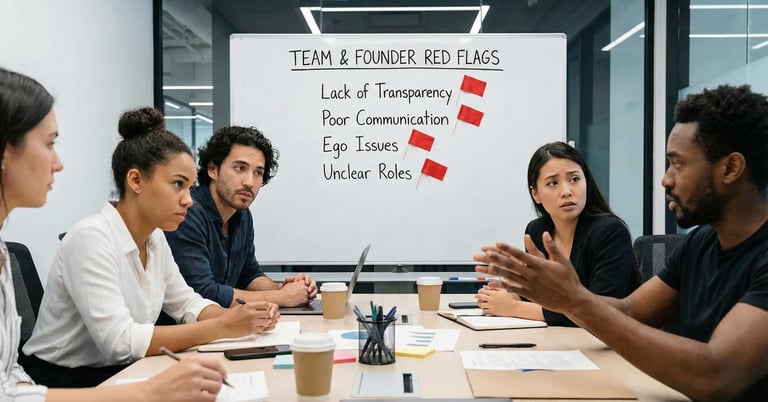

Team & Founder Red Flags: The Forensic Audit of Leadership
Investors invest in lines, not dots. But at the Seed stage, the only "dot" they have is you. If the dot looks unstable, they won't bet on the line.
In the early stages of a startup, the "Team" slide is not a resume dump; it is a Risk Assessment. While you view this slide as a showcase of your achievements, the investor views it through the lens of "Key Person Risk" and "Execution Latency."
Investors operate under a simple, ruthless heuristic: "Product-Market Fit is luck; Founder-Market Fit is destiny." A mediocre team will kill a great idea (by moving too slow, hiring the wrong people, or fighting amongst themselves), but a great team will pivot a bad idea into a unicorn. History is littered with "Pivot Success Stories" (Slack started as a video game; Twitter started as a podcasting platform). These pivots were only possible because the Team was antifragile.
When a General Partner (GP) audits your Team slide, they are performing a forensic "Capability & Stability" check. They are asking three existential questions:
Can you build it? (Technical Risk: Do you own the code?).
Can you sell it? (Distribution Risk: Can you close the first 10 deals?).
Will you stay together? (Dynamics Risk: Will you divorce when the stress hits?).
Most founders fail this audit by cluttering the slide with "Advisors" (who don't work there), inflating titles ("Chief Strategy Officer" at a 3-person company), or obscuring the true nature of their equity split. These are not just design choices; they are "Insecurity Signals."
This analysis is a surgical dissection of Team & Founder Red Flags. We will explore the forensic signals of "The Outsourced Brain," the dangers of "Part-Time Founders," the "Family Business" risk, and the Equity Split warnings that scream "Future Lawsuit."
This sub pillar is part of our main Pillar 11 : Mistakes, Red Flags & Investor Judgment
The Trench Report: The "Agency" Trap (A Series A Collapse)
In Q3 2025, I audited a Fintech founder in London. He was raising £8M ($10M). The product was a complex algorithmic trading platform for retail investors. The traction was solid ($1M ARR), and the user interface was slick.
The Structural Error:
I looked at the Team Slide. It featured three polished photos:
CEO: Ex-Investment Banker (Sales/Vision).
COO: Ex-Management Consultant (Ops).
CMO: Ex-Digital Agency (Marketing).
The Forensic Gap:
I asked the obvious question: "Where is the CTO?"
The founder replied confidently, "Oh, we have a 'Head of Engineering' listed on the next slide, but effectively we use a dev shop in Ukraine. They are incredible; they built the whole MVP. We view them as partners."
The Investor Reaction:
The deal died instantly. The Term Sheet was pulled.
The Logic:
You cannot be a "Tech Company" if you do not own your "Tech."
The Agency Risk: If the agency raises prices, you are held hostage. If the lead developer at the agency quits, you lose all institutional knowledge of your code.
The Speed Risk: An agency optimizes for billable hours; a CTO optimizes for speed and scalability.
The Valuation Impact: Investors do not pay 10x Revenue multiples for a "Service Business." By outsourcing the core IP, the founder had turned a Tech Startup into a Marketing Agency wrapped in code.
The Technical Pivot:
We had to pause the raise for 3 months to restructure the company DNA.
The Fix: The founder had to hire a full-time "Head of Engineering" (poached from a competitor like Revolut) and grant them significant equity (7% post-traction) to bring the code in-house.
The Narrative Shift: "We built the MVP with an agency for speed and capital efficiency. That phase is done. Now, we have hired [Name] to build the proprietary enterprise infrastructure."
The Result: The investor returned. The risk was mitigated because the IP was now "in the building."
The Forensic Formula: The Founder Dependency Ratio Fd
Investors assess how reliant the business is on the CEO vs. the System.
Fd = Revenue Generated by Founder Sales
Total Revenue
Forensic Benchmarks:
Fd > 90%: The "Solo Genius" Trap. If the CEO gets sick, revenue stops. This is a consulting firm, not a startup. It is hard to scale because the CEO's time is the bottleneck.
Fd < 40$: The "System" Win. The sales team is working. The playbook has been extracted from the founder's brain and documented. This is an investable asset.
The Taxonomy of Team Red Flags
There are specific structural setups that signal "Amateur Hour" to a VC. You must scrub these from your deck immediately.
1. The "Advisor Wall" (The Insecurity Signal)
The Mistake: A slide featuring 2 founders and 8 "Advisors" (with logos of Google, Facebook, Stanford, McKinsey).
The Forensic Reality: Investors know the game. Advisors usually receive 0.25% equity and take one call a month (if that). They do not do the work. They do not ship code. They do not close deals.
The Signal: "We are insecure about our own credibility, so we are hiding behind these famous logos to borrow authority." It dilutes your own standing.
The Fix: Move Advisors to the Appendix. If they aren't in the trenches getting shot at with you, they aren't on the "Team" slide. Only list an advisor if they are an industry legend who is actively opening doors (e.g., "Former FDA Commissioner" for a MedTech startup).
2. The "Title Inflation" (The C-Suite of Nothing)
The Mistake: A 4-person company having a CEO, COO, CFO, and Chief Strategy Officer (CSO).
The Forensic Reality: A Seed stage startup does not need a "Chief Strategy Officer." It needs a "Coder" and a "Seller." A "CFO" at a pre-revenue startup is usually a glorified bookkeeper.
The Signal: "We care more about ego and status than execution." It signals a "Corporate Cosplay" mindset rather than a "Scrappy Builder" mindset.
The Fix: Use functional titles. "Head of Product," "Lead Engineer," "Head of Growth." It shows humility and focus on the work, not the rank.
3. The "Part-Time" Founder
The Mistake: Listing a co-founder with an asterisk: "Currently at Google, joining full-time upon funding."
The Forensic Reality: Investors do not fund "Options." They fund "Commitments." If you haven't jumped, you don't believe in the parachute.
The Signal: "I want you (the investor) to take the financial risk so I don't have to." This misalignment of risk appetite is fatal.
The Fix: You must jump. If you cannot afford to quit, raise a "Friends & Family" round to cover 3 months of ramen salary. But you must be "All In" before the VC meeting.
4. The "Family Business" Risk
The Mistake: Co-founders who are married, siblings, or dating.
The Forensic Reality: This introduces "Emotional Volatility Risk." If the personal relationship fails, the company likely dies. It also makes it impossible to fire a co-founder for underperformance without destroying the company culture.
The Signal: Governance nightmare.
The Fix: If you are a couple, you must have a "board-level" mechanism for dispute resolution documented. You must prove you have worked together professionally before this venture. (e.g., "We built and sold our last company together").
5. The "Academic" Trap
The Mistake: A team of three PhDs with zero commercial experience.
The Forensic Reality: Great at technology, terrible at product. Investors worry you will spend 3 years perfecting the algorithm and 0 days talking to customers.
The Signal: "R&D Lab," not "High-Growth Business."
The Fix: You need a "Commercial Co-Founder" or a strong "Head of Sales" on the slide to balance the equation.
Regional Calibration (SF vs. London)
The definition of an "Elite Team" changes by zip code.
San Francisco (The "Mercenary" Filter)
The Archetype: Ex-Stripe, Ex-OpenAI, Ex-Airbnb, Ex-YCombinator.
The Thesis: "They have seen hyper-growth. They know the playbook. They operate at 'Silicon Valley Speed'."
The Pitch: Highlight the companies you built, not your degrees. "I scaled the Uber driver team from 100 to 10,000."
Red Flag: Career consultants (McKinsey/Bain) or corporate lifers (IBM, Oracle) are often viewed as "too slow" or "too theoretical" for early-stage chaos.
London / Europe (The "Expert" Filter)
The Archetype: PhD in AI from Cambridge, 10 Years in Supply Chain Management, Ex-Goldman Sachs.
The Thesis: "They understand the nuance of the problem. They have the network to navigate the regulatory landscape."
The Pitch: Highlight the domain expertise and academic rigor. "I wrote the European standard for Carbon Compliance."
Red Flag: "Generalist" founders with no sector experience trying to disrupt a complex industry (e.g., a 22-year-old building a MedTech device).
The Equity Split "Tell"
The Cap Table tells the real story of the relationship. Investors will ask for the "Cap Table Summary" during diligence. What they see there often kills the deal.
Red Flag 1: The "90/10" Dictator
The Setup: CEO owns 90%, CTO owns 10%.
The Signal: This is not a partnership; it is an employment contract. The CTO is effectively an employee with a bonus.
The Risk: When the startup hits the "Trough of Sorrow" (and it will), the CTO will leave because 10% isn't enough upside to suffer for years. Investors invest in teams, and a 90/10 split signals a "Solo Founder" with a helper.
The Fix: Co-founder splits should be roughly equal (e.g., 60/40 or 50/50) at the earliest stage to align incentives. If the split is unequal, there must be a clear logic (e.g., one founder put in $100k cash).
Red Flag 2: The "Dead Equity" (The Ex-Founder)
The Setup: A co-founder left 6 months ago but still owns 30% of the company because there was no vesting schedule.
The Signal: The company is "Uninvestable." New investors will not pump money into a company where 30% of the upside goes to a guy sitting on a beach doing nothing.
The Risk: It demoralizes the remaining team and ruins the math for future rounds (not enough equity left for the option pool).
The Fix: "Reverse Vesting." You must clean up the cap table before pitching. Negotiate a buyback of the dead equity. If you can't, you might need to dissolve and restart (extreme case).
Red Flag 3: The "No Vesting" Rookie Mistake
The Setup: Founders own their shares outright from Day 1.
The Signal: You don't understand VC standards.
The Protocol: Standard Vesting. 4 Years, 1 Year Cliff.
Cliff: If you leave before 1 year, you get 0%.
Vesting: After 1 year, you earn 25%, then monthly thereafter.
Why: This protects the company (and the investor) if a co-founder walks away.
Earned Secrets
Hidden levers of team evaluation that seasoned operators use to clear the board.
Secret 1: The "Dating" Question
The Secret: The #1 cause of startup death is Co-Founder Conflict (65% of failures).
The Hack: Investors will ask: "How long have you known each other?"
Bad Answer: "We met 2 months ago at a Hackathon." (High Divorce Risk—you haven't fought yet).
Good Answer: "We worked together for 3 years at [Company] and shipped two products together." (Battle Tested).
The Fix: If you are new, build a "Trial Period" narrative. "We spent 3 months building the MVP nights and weekends to test our conflict resolution style before incorporating."
Secret 2: The "Hiring Magnet" Proof
The Secret: A CEO's main job is not to build product; it is to hire people smarter than them.
The Hack: Show a slide called "The Bench" or "Pending Hires."
The Script: "We have 3 senior engineers from [Top Company] ready to join the day we close the round. Here are their redacted profiles."
The Signal: This proves you can sell the vision to talent, not just investors. Talent flows to momentum.
Secret 3: The "Reference Blindspot" (Backchanneling)
The Secret: Investors will call people you didn't list as references. They will look at your LinkedIn, find mutual connections (ex-bosses, ex-colleagues), and call them.
The Hack: Be proactive. Audit your own reputation.
The Move: If you have a "Bad Boss" in your past who might badmouth you, get ahead of it. "You might speak to X. We had a strategic disagreement on Y. Here is what I learned from that experience." Controlling the narrative is better than hiding it.
Expert FAQ: The Unasked Questions
Q: Should I include interns on the Team slide?
A: Forensic Answer: No.
Why: It inflates the headcount artificially. Investors will do the math: "You have 10 people but only $10k MRR? You are inefficient."
Rule: Only list Full-Time Employees (FTEs) or key contractors who own a critical outcome. Quality > Quantity.
Q: What if we are two business founders (Two MBAs)?
A: Forensic Answer: Huge Risk.
Why: You are a "Marketing Agency," not a Tech Company. You have two people who can make decks, and zero people who can write code.
Pivot: One of you needs to learn to code (No-Code counts for MVP) or you need to bring on a technical partner immediately. Do not pitch until you have a technical lead.
The Narrative: "I am the Product CEO (Wireframing/Specs), and he is the Sales COO." Differentiate the roles clearly.
Q: How do I handle a "Solo Founder" objection?
A: Forensic Answer: Own the "Speed" narrative.
The Objection: "Solo founders burn out. You have no sparring partner."
The Script: "I am solo by design for speed in the zero-to-one phase. Decision latency is zero. However, I have a strong 'Head of Engineering' who acts as a technical partner, and I am allocating a 15% option pool to bring in a C-level operator at Series A once we hit $2M ARR."
Q: Should we list our degrees?
A: Forensic Answer: Only if relevant.
Yes: If it's a PhD in the specific science you are commercializing.
No: If it's a generic BA in History for a SaaS company. Stanford/MIT/Harvard are the exceptions; keep those for the "Signal."
Forensic Audit Checklist
Before you finalize the Team slide, run the "Leadership Diagnostic":
The "Logo" Check: Do the logos under your photos represent meaningful work (2+ years), or just 3-month internships? Be honest. Investors will check LinkedIn.
The "Skill" Grid: Do you cover the 3 bases: Product (Build), Sales (Sell), Ops (Keep). If one is missing (e.g., no sales DNA), acknowledge the hiring plan in the "Use of Funds."
The "Photo" Audit: Are the photos professional? (No wedding crops, no sunglasses, no low-res selfies). You are asking for $2M; look like you can manage it.
The "Advisor" Purge: Delete the advisors unless they are industry legends who actively help.
The "Bio" Tweet: Can you describe your superpower in 140 characters? (e.g., "Scaled Uber Eats from 0 to 1M orders" vs. "Experienced Manager"). Use metrics in your bio, not adjectives.
Narrative Breadcrumb
You have proven the team is capable, stable, and has "Founder-Market Fit." You have scrubbed the "Advisor Wall" and clarified the equity split. The investor believes you are the right people to solve the problem.
But a great team and a great market are nothing without a plan. The investor's final question is: "How do you actually go to market?" You must now transition to the "Go-to-Market (GTM) & Strategy" slide to prove you can acquire customers cheaper than you can monetize them.
(Note: The Funding Blueprint Kit includes Founder-Proofed Frameworks built on real-world investor reactions and the Slide-By-Slide VC Instruction Guide. These resources decode the specific VC psychology behind every potential objection, ensuring you don't just memorize a script, but internalize the logic required to survive the audit. Access the full forensic suite at the home page.)
Funding Blueprint
© 2025 Funding Blueprint. All Rights Reserved.