
Storytelling & Narrative Mistakes: The Forensic Audit of Founder Delusion
Storytelling Mistakes: Investors hate your "Hero's Journey." Cure "Main Character Syndrome" with the Forensic Narrative Audit to prove market urgency in 2026.
PILLAR 11 : MISTAKES, RED FLAGS & INVESTOR JUDGMENT
1/8/20269 min read
Storytelling & Narrative Mistakes: The Forensic Audit of Founder Delusion
"The Hero’s Journey" is for Screenplays, Not Term Sheets.
Most founders operate under a catastrophic misconception regarding "storytelling." They have been trained by startup accelerators and Medium articles to treat their pitch deck like a Hollywood script. They focus on the emotional arc, the "struggle" of the protagonist (the founder), and the climactic reveal of the product.
This is a fundamental capital allocation error. Institutional investors are not buying a story; they are buying a derisked asset class.
When you utilize the "Hero's Journey" framework, you are asking an investor to empathize with your struggle. Empathy is a "System 2" emotion—it requires effort and slows down decision-making. The highest-converting narratives in 2025 are not emotional stories; they are Legal Arguments. They present a thesis ("The Market is Broken"), provide evidence ("Here is the Data"), and demand a verdict ("Invest or Miss Out").
If your narrative requires the investor to "believe" in you rather than "calculate" your trajectory, you have already lost. This guide performs a forensic audit on the narrative structures that trigger immediate "Pass" decisions in Tier-1 Venture Capital firms.
This sub pillar is part of our main Pillar 11 : Mistakes, Red Flags & Investor Judgment
The Trench Report: The $14M Series A Pivot
Deal Context: B2B Enterprise SaaS (New York/London dual presence).
The Status: The company had strong fundamentals: $2M ARR, growing 2.5x Year-over-Year (YoY), and 110% Net Revenue Retention (NRR).
The Problem: Despite the metrics, the founder had received 20 consecutive "Pass" emails from Tier-1 VCs in New York and Boston. The feedback was consistently vague: "Not high enough conviction," or "We don't see the platform potential."
The Forensic Diagnosis:
We audited the deck using a "Cognitive Load" heat map. The founder was using a Chronological Narrative.
Slides 1-5: Detailed the history of the industry, how the founders met, the "journey" of discovery, and the philosophy behind the code.
Slide 8: Finally revealed the $2M ARR traction.
The Failure Point: By the time investors reached Slide 8, they had already mentally checked out. The "History Lesson" created excessive Cognitive Debt. The investor was forced to work too hard to find the alpha.
The Technical Pivot:
We completely restructured the deck using Assertion-Led Logic. We moved from "Storytelling" to "Evidence Stacking."
The Structural Inversion: We moved the Traction Slide (Metric Integrity) to Slide 2, immediately after the Title Slide.
The Logic: We forced the investor to anchor on the hard numbers ($2M ARR) before they heard a single word about the product. This changed the frame of the meeting. The investor wasn't thinking, "Is this idea good?" They were thinking, "How did they make $2M so fast?"
The "Origin Story" Deletion: We deleted the "How we met" slide entirely. We replaced it with a "Market Failure" Thesis.
Before: "We realized that supply chains are inefficient."
After: "Current ERPs result in a 14% net margin leakage due to asynchronous data." (Specific, measurable, expensive).
The Visual Anchor: We replaced generic stock photos of "connected dots" with a blurred screenshot of their actual bank ledger showing incoming wire transfers.
The Outcome:
The narrative shifted from "passionate team trying hard" to "inevitable market correction."
The Result: A Term Sheet was secured from a lead investor in NYC at a $65M pre-money valuation within 21 days of the restructure. The "story" didn't change; the Information Architecture did.
Forensic Analysis: System 1 vs. System 2 Thinking
Mistake: Triggering "System 2" Skepticism.
To raise capital successfully, you must understand the cognitive architecture of the person sitting across the table. Daniel Kahneman’s framework of Thinking, Fast and Slow is the governing dynamic of VC pitch meetings.
System 1 (The Check Writer): Fast, intuitive, automatic. This is where "Pattern Recognition" lives. VCs see thousands of decks; they look for patterns that match "Unicorn." You want to keep them here.
System 2 (The Auditor): Slow, analytical, suspicious. This is where "Due Diligence" lives. When an investor gets confused, they switch to System 2 to find the flaw.
Forensic Term: Narrative Velocity.
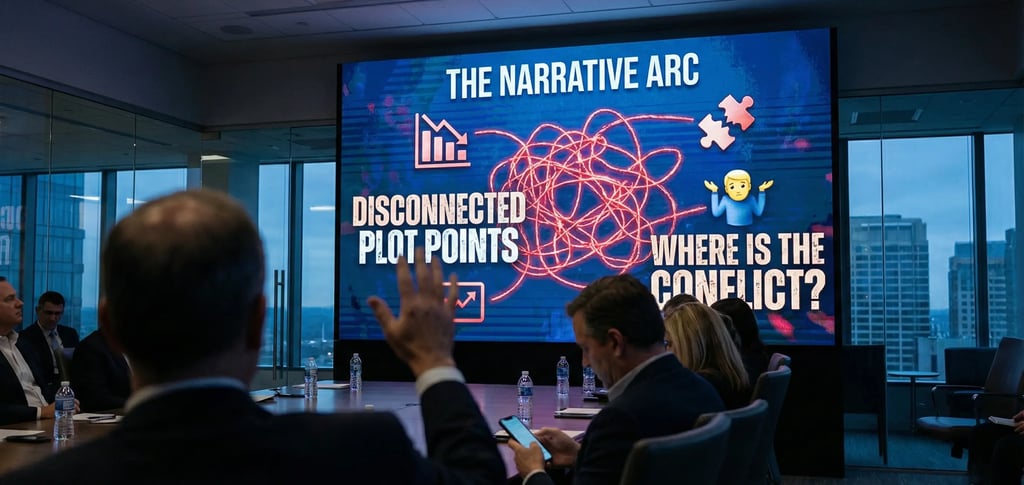
The speed at which a slide transmits value must exceed the speed at which the investor generates objections. When your narrative is disjointed, you force the investor to stop and ask, "Wait, how does that relate to the previous slide?" This pause is fatal. It breaks the "Reality Distortion Field."
The "Mystery Box" Error:
Founders often try to build suspense by revealing the solution at the end of the deck (Slide 10).
The Forensic Reality: Investors hate suspense. Suspense equals risk.
The Fix: Use the Inverted Pyramid Structure. State the conclusion first, then provide the supporting data.
Weak (Inductive): "We noticed X, then we built Y, and early tests show Z."
Strong (Deductive): "We reduce logistics fuel spend by 18%. We do this via [Mechanism Y]. Here is the proof [Data Z]."
Visual Audit of Narrative Velocity:
Low Velocity: Paragraphs of text explaining the "Why."
High Velocity: A split-screen comparison. Left side (Red): "Old Way: 14 Steps." Right side (Green): "New Way: 1 Step." The brain processes the contrast in 150 milliseconds.
Narrative Breadcrumb: There is a specific phrasing for the "Competition" slide that forces an investor to view your high burn rate as a Competitive Moat rather than a financial risk. Most founders get this backward and apologize for their burn.
SF vs. London vs. Toronto
The definition of a "Good Story" is not universal. It is geographically dependent on the liquidity environment and the risk appetite of the local Limited Partners (LPs).
San Francisco (The "Velocity" Narrative)
The Mindset: "What if this works?" SF investors are looking for the outlier that returns the entire fund.
The Narrative Mistake: Pitching "profitability" or "downside protection" too early. In SF, a narrative focused on saving money signals a lack of ambition. It suggests you are building a "Lifestyle Business," not a "Fund Returner."
The Narrative Fix: "We are building the operating system for [Industry X]." The story must imply an Inevitable Monopoly. You must show how you capture the majority of the value in the ecosystem.
Key Metric: TAM Expansion. Show how your initial wedge ($1B Market) unlocks adjacent markets ($50B Market).
London (The "Audit" Narrative)
The Mindset: "What if this fails?" UK investors are often deploying capital from more conservative LPs or government-backed funds. They focus on Unit Economics and downside protection.
The Narrative Mistake: Pitching "World Domination" without a clear path to breakeven. UK investors view high-level abstraction as operational incompetence or American arrogance.
The Narrative Fix: "We have identified a structural arbitrage in [Industry X] and have the unit economics to exploit it." The story must imply Derisked Execution.
Key Metric: Capital Efficiency. Specifically, CAC Payback Period. Prove that for every £1 you burn, you generate £3 in LTV within 12 months.
Toronto / Canada (The "Technical" Narrative)
The Mindset: Conservative, IP-focused, and grant-heavy.
The Narrative Mistake: Ignoring the non-dilutive funding landscape or failing to emphasize technical IP.
The Narrative Fix: Lean heavily into the "Scientific Moat." Show how your tech is defensible not just by speed, but by complexity.
Key Metric: SR&ED Leverage. Show that $1 of VC money equals $1.40 of operating power due to government matching.
3 Red Flags in Narrative DD
A broken narrative isn't just "bad writing"; it signals broken math. Investors use your narrative inconsistencies to identify where to dig during Technical Due Diligence (DD).
Red Flag 1: The "Product-Led Growth" (PLG) Narrative Mismatch
The Narrative Claim: "We are a PLG company with viral loops." (Founders say this because PLG multiples are higher).
The Forensic Audit: The investor looks at your P&L. If you claim PLG but your Sales & Marketing spend is 60% of revenue, you are lying. You are a Sales-Led company masquerading as PLG.
The Metric Logic: If your story is "Viral," your SaaS Magic Number must be > 1.0.
SaaS Magic Number = Current Qtr ARR - Prev Qtr ARR
Prev Qtr Sales & Mktg Spend
If this number is < 0.7, your "Viral" narrative is mathematically false. You are buying growth, not earning it.
Red Flag 2: The "Platform" Delusion
The Narrative Claim: "We are building an all-in-one platform."
The Forensic Audit: Pitching a multi-product platform before Series B is a red flag. It suggests a lack of focus.
The Metric Logic: Complexity kills margins. Investors track the Complexity Tax.
Complexity Tax = R&D Spend
Net New ARR
If your R&D spend is increasing faster than your New ARR because you are building 5 features at once, your "Platform" story is actually a "Technical Debt" story.
Red Flag 3: The "Conservative" Projection
The Narrative Claim: "We prefer to under-promise and over-deliver, so these numbers are conservative."
The Forensic Reality: In VC, "conservative" reads as "I don't understand the Power Law." If you project a 2x return, the VC cannot invest. They need a path to 100x.
The Fix: You need Scenario Modeling.
Base Case: 3x growth (Good business).
Stretch Case: 10x growth (Venture Case).
You must pitch the Stretch Case as the goal, but defend the Base Case with logic.
Non-Obvious Information Gain
These are the hidden narrative levers that seasoned operators use to clear the board. These insights are rarely discussed publicly because they constitute the "Game Theory" of fundraising.
Secret 1: The "Option Pool" Narrative (US vs. UK)
The Context: The "Hiring Narrative" is a critical sub-plot in your deck. You need to prove you can attract mercenaries.
US Secret: You must show a large unallocated option pool (15-20%) pre-money. This signals to US investors that you understand the "War for Talent" in Silicon Valley and are prepared to grant heavy equity packages to steal engineers from Google.
UK Secret: In London, a massive option pool can sometimes backfire if not framed correctly. European employees historically value cash and job security higher than equity (though this is changing). If you allocate 20% to the pool in a UK deck, you must explain exactly who you are hiring, or it looks like unnecessary dilution.
Secret 2: The "Bridge Round" Naming Convention
The Mistake: Explicitly calling your round a "Bridge Round" in the deck title.
The Psychology: "Bridge" implies you ran out of money before hitting your milestones. It smells of distress.
The Pivot: Never tell a story of "survival." Rename the round.
Bad: "Bridge to Series A."
Good: "Momentum Round" or "Pre-Emptive A."
The Truth: The math (convertible note, discount) is identical. But the narrative changes from "Help us survive" to "Pay to get on the rocket early." Valuation caps are significantly higher for "Momentum Rounds" than "Bridge Rounds."
Secret 3: Operational Debt via "Founder-Led Sales"
The Secret: Many founders brag about having "$0 Sales Headcount" to prove how efficient they are.
The Trap: Sophisticated investors see this as Key Person Risk. If the founder gets hit by a bus, revenue stops.
The Narrative Fix: Do not brag about doing the sales. Brag about building the system.
Narrative: "We have built a sales playbook that is currently founder-led, but is documented and ready for extraction/delegation."
You must prove that the process exists independent of the personality.
Expert FAQ: The Unasked Questions
Q: Where do I specifically place the "Team" slide?
A: This is a function of your "Asset Class."
Slide 2 (The Authority Frame): If you are a second-time founder with a confirmed exit, or if you were a VP at a Decacorn (Uber, Airbnb, Stripe). In this case, YOU are the asset. The investor is betting on the jockey, not the horse.
End of Deck (The Execution Frame): If you are a first-time founder or lack "Logo Prestige." If you put a "weak" team slide first, you create a bias that discounts the rest of the deck. Make them fall in love with the Traction (Slide 2) and the Market (Slide 3) first. By the time they get to the end, they won't care who you are; they will care what you built.
Q: How long should the "Problem" section be?
A: One slide. Maximum.
The Reason: Spending 4-5 slides defining the "Problem" signals that you are a Consultant, not a Builder. Consultants love to analyze problems; Builders love to sell solutions.
The Rule: If you cannot articulate the market failure in one slide, you do not understand the market well enough to disrupt it.
Q: Should I use video in the deck?
A: No. Never.
The Technical Reason: It breaks the flow (System 1 to System 2 switch). It creates file-size friction (email bounce backs). It rarely plays correctly on mobile devices.
The Narrative Reason: You are ceding control of the timing. You want the investor to read at your pace.
The Exception: Use a high-quality GIF (under 5MB) to show UI motion or a specific "Aha!" interaction.
Q: How do I handle the "Competition" slide without looking arrogant?
A: The "Magic Quadrant" (2x2 Matrix) is dead. It is a cliché that signals delusion.
The Fix: Use a "Feature Audit" Matrix.
Rows: Competitors.
Columns: Critical Buying Criteria (Speed, Integration, Compliance).
Cells: Data (e.g., "2 days" vs "20 days").
This transforms the slide from opinion ("We are better") to fact ("We are faster based on this benchmark").
Forensic Audit Checklist
Before hitting "Send" or walking into a partner meeting, run this 5-point Squint Test on your narrative flow. If you fail these, your story is broken.
The "So What?" Test: Read only the headers of your slides in sequence. Do they form a coherent, standalone paragraph?
Example: "The Market is Broken" -> "We Fixed It" -> "Here is the Proof" -> "We are Scaling."
If the headers are just labels (e.g., "Problem," "Solution," "Team"), you have failed the Narrative Velocity test.
The Adjective Audit: Ctrl+F for the following words: "Revolutionary," "Disruptive," "Unique," "Passionate," "Transformative."
Action: Delete them all. Replace them with data.
Replace: "Revolutionary Speed" -> "10x Faster Processing."
The Logic Bridge: Does Slide 5 (Solution) mathematically prove Slide 4 (Problem)?
If your Problem is "High Cost," your Solution must be "Lower Price," not "Better UX." Mismatched logic bridges are the #1 cause of confusion.
The TAM Reality Check: Is your SAM (Serviceable Addressable Market) calculated using your pricing model?
SAM = Target Customers X Your ACV
If you use a generic Gartner number for SAM, you will be flagged for "Lazy Analysis."
The Victim Check: Does your story sound like you are the victim of the market (Passive Voice), or the master of it (Active Voice)?
Passive: "The market has been slow to adopt..."
Active: "We are forcing market adoption by..."
A broken narrative is the most expensive mistake a founder can make. It costs you the meeting before you even enter the room. A pretty deck with a broken story is just a well-designed rejection letter.
(Note: The Funding Blueprint Kit includes Founder-Proofed Frameworks built on real-world investor reactions and the Slide-By-Slide VC Instruction Guide. These resources decode the specific VC psychology behind every potential objection, ensuring you don't just memorize a script, but internalize the logic required to survive the audit. Access the full forensic suite at the home page.)
Funding Blueprint
© 2025 Funding Blueprint. All Rights Reserved.