
Slide-Specific Mistakes: The Forensic Audit of Structural Failure
Slide Mistakes: A "Frankenstein Deck" kills deal momentum instantly. Investors demand logical flow, not random data. Fix structural failures with the Forensic Slide Audit to ensure Cognitive Continuity in 2026.
PILLAR 11 : MISTAKES, RED FLAGS & INVESTOR JUDGMENT
1/10/20268 min read

Slide-Specific Mistakes: The Forensic Audit of Structural Failure
Your pitch deck is a chain. It is only as strong as its weakest link. Investors do not look for reasons to say "Yes"; they look for the single broken link that allows them to say "No" and go to lunch.
In the forensic anatomy of a pitch, every slide has a specific "Job to Be Done." The Problem Slide must manufacture anxiety. The Solution Slide must resolve that anxiety. The Business Model Slide must prove monetization. If a slide fails to do its specific job, the narrative chain breaks, and the investor checks out.
Most founders treat the deck as a collection of 12 independent slides. This is fatal. The deck is a "Force Multiplier System." The Market Slide validates the Problem. The Traction Slide validates the Solution. When these slides contradict each other (e.g., you claim a $10B market but show $5k revenue after 3 years), you create "Narrative Dissonance."
This analysis is a surgical dissection of Slide-Specific Mistakes. We will move chronologically through the standard VC deck, identifying the specific "Kill Signals" embedded in each section that signal amateurism to a Tier-1 investor. We will explore the Cognitive Science of Visual Hierarchy, the Psychology of the Ask, and the Mathematics of the Market Slide.
This sub pillar is part of our main Pillar 11 : Mistakes, Red Flags & Investor Judgment
The Trench Report: The "Solution" Overload (A Seed Round Collapse)
In Q4 2025, I audited a DeepTech founder in Berlin. She was raising €4M for an AI-driven protein folding platform. Her technology was world-class, developed at a top institute.
The Structural Error:
Her Solution Slide was a crime scene.
The Visual: It was a high-resolution screenshot of her SaaS dashboard.
The Density: It had 15 call-out bubbles explaining every button ("File Upload," "Export CSV," "User Settings," "API Key").
The Forensic Reality: She was so proud of the features she built that she forgot to explain the value she delivered. She was forcing the investor to do the cognitive work of figuring out why those buttons mattered.
The Investor Reaction: The Partner squinted at the screen, got a headache (Cognitive Load Spike), and asked: "So... what does this actually do for the scientist?" The momentum died.
The Verdict:
Pass. Feedback: "Product looks too complex. User friction will be high. Sales cycle will be long." The deck made a simple, powerful tool look difficult and messy.
The Technical Pivot:
We deleted the screenshot entirely.
The Fix: We replaced the "Interface" with the "State Change."
The Visual: A "Before & After" split screen.
Left Side (Red): "Old Process: 14 Days of Wet Lab Work. Cost: €5,000."
Right Side (Green): "New Process: 4 Hours of Compute. Cost: €50."
The Result: The investor understood the ROI instantly. The UI didn't matter; the time and money savings mattered.
The Forensic Formula: The Signal-to-Noise Ratio Rsn
Every slide must have one dominant takeaway.
Rsn = 1 Main Heading (The Insight)
Number of Visual Elements
Forensic Benchmarks:
Rsn < 0.1: Noise. (e.g., 1 Heading, 20 Bullet points). The investor cannot scan it. They will read nothing.
Rsn > 0.5: Signal. (e.g., 1 Heading, 1 Chart, 1 Insight). High impact. The brain processes it in <3 seconds.
The Slide-by-Slide Kill List
Here are the specific forensic failures for the critical slides in the deck, expanded with forensic psychology.
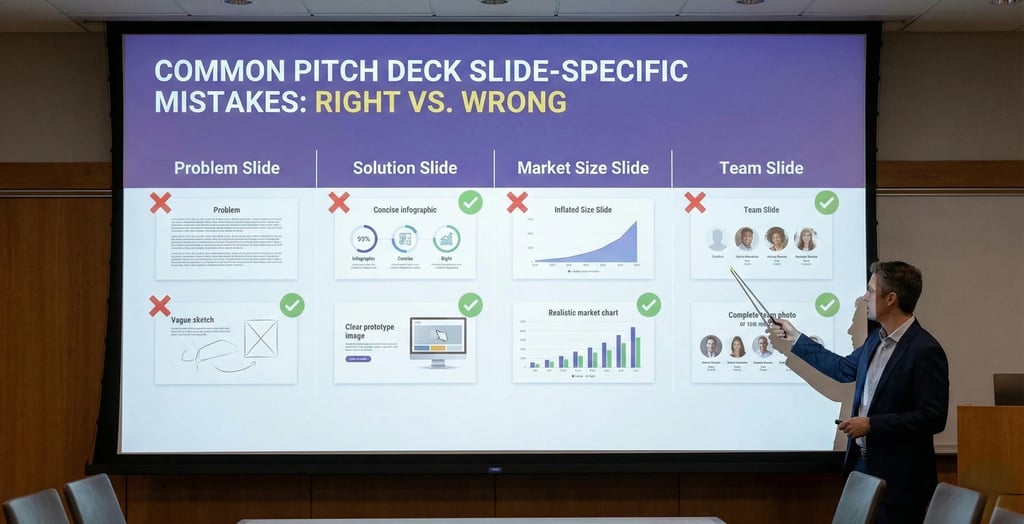
1. The Problem Slide: The "Wikipedia" Error
The Mistake: Defining a problem everyone knows exists.
Example: "Climate Change is bad." (We know).
Example: "Cybersecurity threats are rising." (We know).
The Forensic Fix: Define the "Specific User Agony." Move from Macro to Micro.
Correction: "Compliance Officers spend 20 hours a week manually pasting CSVs into Excel to report carbon data. It costs companies $50k/year in wasted labor and results in 15% error rates."
The Signal: You understand the mechanics of the pain, not just the headline. You have empathy for the user.
The "Vitamin vs. Painkiller" Test: If your problem slide describes an "annoyance," you are a Vitamin (Nice to have). If it describes "agony" or "loss," you are a Painkiller (Must have).
2. The Solution Slide: The "Feature Dump"
The Mistake: Listing 10 features (AI, Cloud, Mobile, Fast, Secure, Scalable).
The Forensic Fix: Focus on the "Magic Moment."
Correction: Show the one thing your product does that was previously impossible. "We auto-populate the report in 3 seconds using OCR."
The Signal: Focus. You know what matters. If you list 10 things, you have built nothing great. If you list 1 thing, you have a wedge.
3. The "Why Now?" Slide: The "We Are Smart" Fallacy
The Mistake: "We are doing this because we are geniuses."
The Forensic Reality: Why didn't Google do this 5 years ago?
The Fix: Identify the "Enabling Technology" or "Regulatory Shift."
Correction: "5 years ago, GPU costs were too high to run this model. In 2024, costs dropped 90%, making this unit-economic positive for the first time."
The Signal: You are riding a wave, not swimming upstream.
4. The Business Model Slide: The "Multiple Revenue Streams" Lie
The Mistake: "We make money via Subscription, Ads, Data Sales, and Consulting."
The Forensic Reality: No seed startup has 4 revenue streams. You are throwing spaghetti at the wall. It signals a lack of conviction.
The Signal: You don't know your business model yet.
The Fix: Pick ONE. "We are a SaaS business. We charge $50/seat." Monetize the data later. Simplicity scales; complexity stalls.
5. The Go-to-Market (GTM) Slide: The "Laundry List"
The Mistake: "We will do SEO, PPC, Content Marketing, and Partnerships."
The Forensic Reality: This is a list of channels, not a strategy. Everyone "does SEO." It tells me nothing about your specific advantage.
The Fix: "The Unit Economics Play."
Correction: "We acquire customers via LinkedIn Cold Outreach using a proprietary scraper. Our CAC is $500. We recover it in Month 2. We are pouring 50% of the funds into scaling this specific channel."
The Signal: You are an Operator, not a Marketer.
6. The Competition Slide: The "Empty Quadrant"
The Mistake: A 2x2 matrix where you are top-right and the rest are bottom-left.
The Forensic Fix: "The Feature Grid" or "The Petal Diagram."
Correction: "We lose on 'Price' to the incumbents (Excel). We win on 'Speed' against the startups. We win on 'Compliance' against the legacy players."
The Signal: Radical Transparency. Admitting where you lose makes the claim of where you win believable.
7. The "Ask" Slide: The "Range" Error
The Mistake: "Raising $3M - $5M."
The Forensic Reality: This signals indecision. Do you need $3M or $5M? The operational plan for $3M is totally different from $5M.
The Fix: "Specific Number, Specific Milestone."
Correction: "Raising $4M to reach $1.5M ARR and unlock Series A metrics (18 months runway)."
The Signal: Precision. You know exactly what you need to buy the next level of valuation.
Regional & Stage Calibration
Slide emphasis changes by geography.
San Francisco (The "Vision" Emphasis)
Critical Slide: The "Why Now?" Slide.
The Test: Why is this possible today when it wasn't 3 years ago? (e.g., "LLMs just made this marginal cost zero").
The Failure: Pitching a timeless idea. "People always need food." (Boring). They want "The New Thing."
London / New York (The "Model" Emphasis)
Critical Slide: The Unit Economics Slide.
The Test: Can you prove the machine works?
The Failure: Hiding the CAC/LTV ratio. If you leave this out in London, the meeting ends early. They want to see the P&L logic.
Visual Red Flags
Design choices signal operational competence. The aesthetics of your deck are a proxy for the quality of your code/product.
Red Flag 1: The "10-Point Font"
The Error: Cramming a paragraph of text onto a slide because you are afraid to leave out detail.
The Forensic Meaning: You lack the ability to prioritize information. You are insecure. You are writing for yourself, not the audience.
The Fix: "The Billboard Rule." If you can't read the slide from the back of the room (or on a phone screen), cut the text by 50%. A slide is for Impact, a Memo is for Reading.
Red Flag 2: The "Inconsistent Design"
The Error: Slide 3 has a blue header. Slide 4 has a green header. Fonts change from Arial to Helvetica.
The Forensic Meaning: "Attention to Detail" is low. If your deck is messy, your code is messy. If you can't align a text box, you can't align a sales team.
The Fix: Use a Master Template. Consistency > Beauty.
Red Flag 3: The "Unlabeled Axis"
The Error: A chart going up without numbers on the Y-axis.
The Forensic Meaning: You are hiding the scale because the numbers are small. You are treating the investor like an idiot.
The Fix: Label the axis. If the numbers are small, own them. "We are at 100 users, but growing 50% WoW." Growth rate matters more than absolute scale at Seed.
Earned Secrets
Hidden levers of slide mastery that elite founders use.
Secret 1: The "Summary" Slide (The Executive Summary)
The Secret: VCs often only read the first slide. If they like it, they read the rest.
The Hack: Your Slide 1 should not be just the logo. It should be the "TL;DR."
Structure: "We are [Company]. We solve [Problem] for [Customer]. We have [$X Revenue]. We are raising [$Y]."
The Effect: It frames the rest of the deck. They know what they are looking at. It reduces cognitive load.
Secret 2: The "Social Proof" Banner
The Secret: Logos build trust faster than words.
The Hack: Put a "Footer" on every slide (the bottom 10% of the pixel height) with your best client logos or angel investor logos.
The Effect: Even if the slide content is boring, their eye drifts to the footer and sees "Nike," "Google," "Sequoia Scouts." It is a subconscious trust anchor that validates every claim on the page.
Secret 3: The "Appendix" Power
The Secret: The main deck is for the Story (System 1 Thinking). The Appendix is for the Audit (System 2 Thinking).
The Hack: Keep the main deck to 10-12 slides. Put the heavy data (Cohort Analysis, Full Financial Model, Tech Architecture, Detailed Bio) in the Appendix.
The Move: When they ask a hard question ("What is your churn by cohort?"), do not answer verbally. Jump to the Appendix. "I have a slide for that." This signals extreme preparedness.
Expert FAQ: The Unasked Questions
Q: How many slides should I have?
A: Forensic Answer: 10-15 Main Slides.
Logic: The human brain can hold ~7 concepts in working memory. 12 slides allows for a coherent narrative arc (Hero, Villain, Struggle, Victory). 40 slides is a textbook, not a pitch.
Q: Should I put the valuation on the Ask slide?
A: Forensic Answer: Never.
Strategy: Valuation is a negotiation, not a presentation. If you write "$20M Cap," you cap your upside (if they would have paid $25M) and kill the deal (if they think $15M).
Script: "The market will price the round. We are looking for the right partner."
Q: Video in deck?
A: Forensic Answer: No.
Why: It breaks. It requires clicking. It lags on Zoom. It has audio issues. It disrupts the flow.
Alternative: Use GIFs. They play automatically, require no audio, and show the product "alive" without the risk of a media player crash.
Q: Should I date the deck?
A: Forensic Answer: No.
Why: If you put "January 2025" and you are still pitching in "April 2025," the investor knows you have been failing for 3 months. Keep it timeless (or update it constantly).
Forensic Audit Checklist
Before you export to PDF, run the "Slide Diagnostic":
The "Squint Test": Squint at the slide. Can you still read the headline? Is the main takeaway obvious? If not, increase font size.
The "So What?" Test: Read the headline. Ask "So What?" If the answer isn't clear, rewrite the headline.
Bad: "Our Technology."
Good: "Our Proprietary AI Reduces Costs by 90%."
The "Orphan" Check: Are there any slides that don't connect to the narrative? Delete them. Every slide must advance the plot.
The "Typo" Scan: Read the deck backwards (Slide 12 to Slide 1). This disrupts your brain's prediction engine and helps you spot typos that you gloss over when reading normally.
The "File Size" Check: Is the PDF < 15MB? (Investors will not download a 100MB file on mobile data). Compress your images.
Narrative Breadcrumb
You have audited your deck. Every slide has a specific job. You have removed the "feature dumps," fixed the "cumulative charts," and sharpened the "Ask." The structural integrity of your argument is now bulletproof.
But a perfect deck is just the entry ticket. It gets you the meeting. It does not get you the money. The money comes from the "Fundraising Strategy"—how you create FOMO, manage the timeline, and close the lead investor. You must now transition to the "Strategic Outreach" phase.
(Note: The Funding Blueprint Kit includes Founder-Proofed Frameworks built on real-world investor reactions and the Slide-By-Slide VC Instruction Guide. These resources decode the specific VC psychology behind every potential objection, ensuring you don't just memorize a script, but internalize the logic required to survive the audit. Access the full forensic suite at the home page.)
Funding Blueprint
© 2025 Funding Blueprint. All Rights Reserved.