
Pitch Preparation & Rehearsal: The Forensic Science of Stress Inoculation
Pitch Preparation & Rehearsal: Amateurs practice until they get it right; pros practice until they can't get it wrong. Master the Stress Inoculation Protocol and Performance Reliability elite founders use.
PILLAR 10 — PITCH DELIVERY
1/5/20267 min read
Pitch Preparation & Rehearsal: The Forensic Science of Stress Inoculation
You do not rise to the occasion; you sink to the level of your training.
The most catastrophic error in fundraising is the belief that "knowing your business" is the same as "knowing your pitch." They are unrelated skills. One is operational competence; the other is performance art under extreme psychological duress.
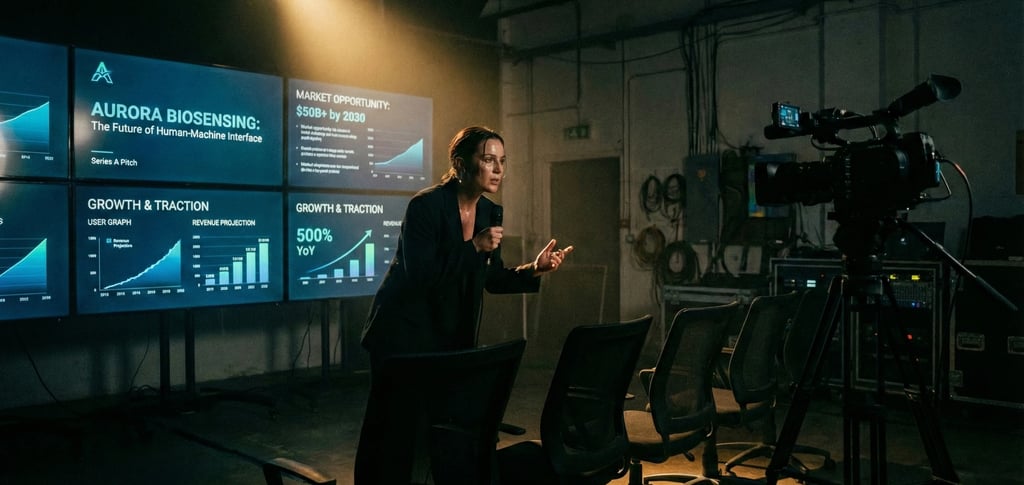
When a founder walks into a Partner Meeting at a Tier-1 fund, their cortisol levels spike to 180% of baseline. Their prefrontal cortex (logic center) is inhibited by the amygdala (threat center). If you have practiced by reading slides quietly to yourself in a mirror, you will fail. That is "Low-Fidelity Rehearsal." It does not simulate the combat conditions of a boardroom interrogation.
In a forensic audit of failed pitches, we rarely find that the founder didn't know the numbers. We find that the founder "froze" when interrupted, fumbled the transition between slides, or failed to control the "Cognitive Load" of the room.
This analysis is a surgical guide to High-Fidelity Pitch Rehearsal. We will strip away the "public speaking tips" and focus on "Stress Inoculation Training"—the same protocols used by elite litigators and special forces to ensure performance when the stakes are existential.
This sub pillar is part of our main Pillar 10 — Pitch Delivery
The Trench Report: The "Freeze" at Series B (A $15M Collapse)
In Q1 2025, I coached a Series B SaaS founder in San Francisco. He was raising $15M. He was charismatic and knew his product cold. He had a meeting with a "Whale" investor known for being aggressive.
The Structural Error:
The founder had rehearsed his "Script." He had memorized a perfect 20-minute monologue.
The Incident: Three minutes into the pitch, the Investor interrupted: "Stop. Your LTV calculation assumes a 3-year life, but your churn is 5% monthly. The math is wrong. Explain that."
The Reaction: The founder’s script was broken. He panicked. He spent 4 minutes fumbling through Excel sheets, sweating, trying to find the cohort data to defend the math. The momentum died. The room went cold.
The Forensic Result:
The investor passed. The feedback: "Founder lacks command of unit economics."
The Reality: The founder knew the economics (the 5% churn was a specific segment, not the blended average). But because he had rehearsed a monologue rather than modules, he couldn't pivot. He suffered from "Recovery Latency."
The Technical Pivot:
We implemented "Red Team Simulations."
The Protocol: We brought in three hostile actors (other founders) to simulate the meeting. Their job was to interrupt him every 90 seconds with aggressive, unfair questions.
The Training: He learned to stop, breathe, answer the specific objection with a "Judo Answer," and smoothly bridge back to the narrative.
The Result:
In the next meeting, when interrupted, he smiled. He answered instantly without looking at notes. He closed the round because he demonstrated "Antifragility" under pressure.
The Forensic Formula: Recovery Latency Lr
You must measure how long it takes to regain control after an interruption.
Lr = Time (seconds) from Interruption to Narrative Resumption
Benchmark:
Lr > 30s: Failure. You look confused.
Lr < 5s: Elite. You look in command.
The "Red Team" Protocol & Modular Fluency
Amateurs memorize scripts. Professionals internalize "Modules." Your pitch is not a linear line; it is a set of Lego blocks (Team Block, Market Block, Product Block) that can be rearranged on the fly based on the investor's attention span.
To achieve this, you must run a "Red Team Simulation."
Phase 1: The "Cold" Run (Cognitive Load Audit)
The Setup: Record yourself pitching the full deck on Zoom without stopping.
The Audit: Watch the recording with the sound off.
What to look for:
"Eye Darting": Are you reading the slides? (Trust killer).
"Hand Flail": Are you using nervous gestures?
"Slide Crutch": Do you say "As you can see on this slide..."? (Lazy narrative).
Phase 2: The "Interruption" Drill (Stress Inoculation)
The Setup: Have a co-founder or advisor roleplay the "Hostile VC."
The Rules: They must interrupt you at least 5 times. They must ask:
"I don't believe this market size."
"Why isn't Google doing this?"
"Your CAC seems too low."
The Goal: Practice the "Bridge." Acknowledge the question, answer it briefly, and bridge back to your flow.
Forensic Technique: "The Pause." When asked a hard question, pause for 2 full seconds before speaking. It signals confidence. An instant answer signals defensiveness.
Phase 3: The "Tech Failure" Drill
The Setup: Simulate a catastrophic tech failure. Your screenshare stops working. The Zoom link fails.
The Goal: Can you pitch without the deck?
The Standard: You must be able to deliver the "Narrative Arc" verbally in 5 minutes without a single visual aid. If you need the slides to tell the story, you don't know the story.
Forensic Formula: The Fluency Coefficient Fc
Fc = Words Spoken per Minute
Filler Words (Um/Ah) per Minute
Logic: High velocity with low fillers = Authority. Low velocity with high fillers = Uncertainty. Use AI transcription tools (Otter.ai) to measure this.
Regional Calibration (SF vs. London)
The "energy" of your rehearsal must match the geography of the money.
San Francisco (The "Jam Session")
The Vibe: Collaborative, High Energy, Interruption-Heavy.
The Rehearsal: Prepare for "Collaborative Jamming." SF investors will interrupt you to brainstorm with you.
The Danger: If you try to stick to your script ("Please let me finish the slide"), you look rigid.
The Pivot: Lean into the interruption. "Exactly! And if we take that idea further..." Treat the pitch as a jazz improvisation.
London / New York (The "Boardroom Audit")
The Vibe: Formal, Reserved, Silence-Heavy.
The Rehearsal: Prepare for "The Poker Face." London investors often sit in silence, taking notes, giving you zero verbal validation.
The Danger: Founders panic in the silence and start babbling to fill the air.
The Pivot: Get comfortable with silence. Deliver your point. Stop. Wait for them to look up. Do not fill the void with nervous chatter.
The Co-Founder "Mom & Dad" Dynamic
If you are pitching with a co-founder, the dynamic between you is scrutinized more than the product. Investors are betting on a marriage.
Red Flag 1: The "Interrupting Cow"
The Error: The CEO is speaking, and the CTO chimes in: "Well, actually, to be more precise..."
The Forensic Reality: This signals Misalignment. It looks like "Mom and Dad fighting." It destroys authority.
The Fix: "Swim Lanes." Define exactly who answers what before the meeting.
CEO: Vision, Market, Sales, Fundraising.
CTO: Product, Architecture, Engineering Team.
Rule: Never add to your co-founder's answer unless explicitly invited. ("Jane, do you want to add detail on the stack?").
Red Flag 2: The "Silent Partner"
The Error: Bringing a co-founder who sits there and says nothing for 45 minutes.
The Forensic Reality: It makes them look like "Dead Weight." Why are they here?
The Fix: Every person in the room must speak within the first 5 minutes, even if just to introduce themselves. If they are not needed for the pitch, leave them at home.
Red Flag 3: The "Look to Mommy"
The Error: When the investor asks the CEO a hard financial question, the CEO looks nervously at the CFO/Co-founder before answering.
The Forensic Reality: The CEO is not in control of the numbers.
The Fix: The CEO must know the "Holy Trinity" (Burn, Growth, Margins) cold. Only defer to the specialist for deep-dive technical nuance.
Earned Secrets
Hidden levers of performance used by elite fundraisers.
Secret 1: The "Zoom Eye Contact" Hack
The Issue: On Zoom, if you look at the investor's face on the screen, you appear to be looking down (breaking eye contact).
The Hack: Move the Zoom window with the investor's video to the top center of your screen, directly under your webcam.
The Effect: When you look at them, you are looking (almost) at the camera. This simulates direct eye contact, creating a subconscious trust bond.
Secret 2: The "Q&A Matrix" Preparation
The Secret: 80% of investor questions are predictable.
The Hack: Create a spreadsheet called the "Q&A Matrix."
Column A: The Question (e.g., "Why won't Amazon kill you?").
Column B: The "Judo Answer" (Bullet points).
Column C: The "Appendix Slide" reference (e.g., Slide 42).
Rehearsal: Have your team quiz you. You must be able to recite the answer and pull up the slide in <5 seconds.
Secret 3: The "Standing Pitch"
The Secret: Sitting down collapses your diaphragm and lowers your energy.
The Hack: Even on Zoom, Stand Up.
The Effect: Your voice projects better. Your hand gestures are more dynamic. You occupy more "space" in the frame. You look like a leader, not a subordinate on a call.
Expert FAQ: The Unasked Questions
Q: Should I use a script?
A: Forensic Answer: No. Write a script to structure your thoughts, then throw it away.
Why: Reading a script kills "Micro-Expressions." Humans trust micro-expressions (the tiny movements around eyes and mouth). If you are reading, your face is dead. Use Bullet Points in the speaker notes only as safety rails.
Q: How do I handle a question I don't know the answer to?
A: Forensic Answer: Do not bluff.
The Trap: Guessing. If you guess and are wrong, you are flagged as dishonest.
The Fix: "The Integrity Pivot."
Script: "I don't have that specific number off the top of my head, and I don't want to give you a guess. Let me run the exact query and email it to you by EOD."
Result: This turns a lack of knowledge into a proof of operational rigor.
Q: What if the investor looks bored?
A: Forensic Answer: Execute a "State Change."
The Technique: Stop the slide share.
The Script: "I feel like I'm talking at you. Let's pause the deck. I want to make sure I'm hitting the points that matter most to your thesis. What's the one thing you're skeptical about right now?"
Result: This forces them to re-engage. It is a high-status move.
Forensic Audit Checklist
Before the meeting starts, run the "Pilot's Pre-Flight Check":
The AV Audit: Is the lighting front-facing? Is the mic distinct from the laptop fan? (Bad audio = Low Intelligence perception).
The "Do Not Disturb" Lock: Are Slack/iMessage notifications disabled? (A pop-up during a screen share is a disaster).
The Deck Cache: Is the deck loaded locally (Keynote/PowerPoint) in case the browser crashes?
The "Appendix" Hotkeys: Do you know the slide number for your "Competition Matrix"? (Type "42" + Enter to jump instantly).
The Water: Do you have water within reach? (Dry mouth kills vocal tone).
Narrative Breadcrumb
You have rehearsed. You have stress-tested your answers. You have defined the swim lanes with your co-founder. You are ready for combat.
You deliver the pitch. It goes well. The Partner nods and says, "This is interesting." But the meeting ends. The deal is not closed. Now you enter the "Follow-Up Zone." This is where momentum is either maintained or lost. The generic "Thank you" email is insufficient. You need a strategy to drive the deal to a Term Sheet.
(Note: The Funding Blueprint Kit includes Founder-Proofed Frameworks built on real-world investor reactions and the Slide-By-Slide VC Instruction Guide. These resources decode the specific VC psychology behind every potential objection, ensuring you don't just memorize a script, but internalize the logic required to survive the audit. Access the full forensic suite at the home page.)
Funding Blueprint
© 2025 Funding Blueprint. All Rights Reserved.