
Pitch Delivery Mistakes & Red Flags: The Forensic Anatomy of Deal Killers
Pitch Delivery Mistakes: Great data cannot save a bad pitch. Master the Unforced Error Rate and "Red Flag" protocols elite London and NYC VCs use to disqualify founders.
PILLAR 10 — PITCH DELIVERY
1/7/20268 min read

Pitch Delivery Mistakes & Red Flags: The Forensic Anatomy of Deal Killers
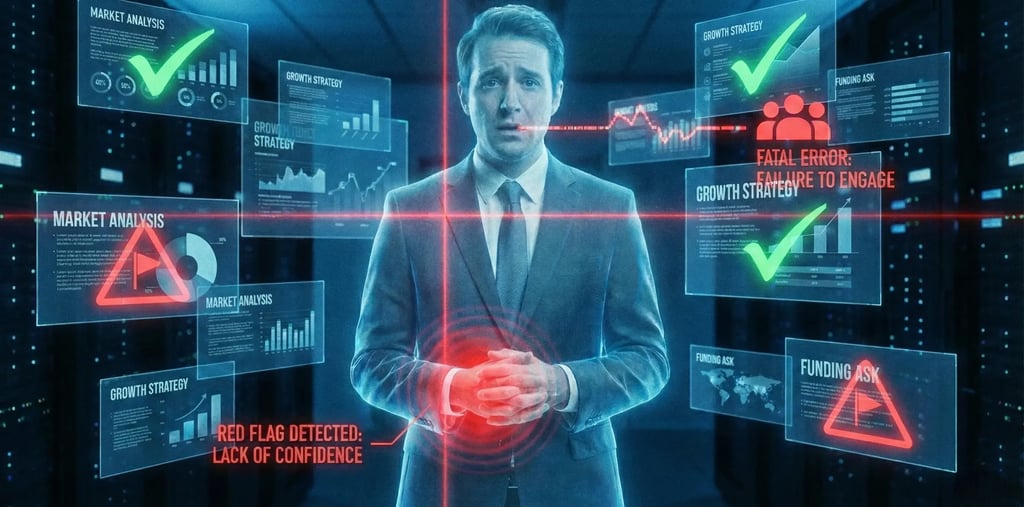
Investors do not invest in businesses; they invest in the people who run them. A pitch delivery mistake is not a "typo"—it is a character flaw revealed in high definition.
In the unforgiving ecosystem of Venture Capital, the meeting is a "Simulation." The investor acts on the assumption that how you behave in the pitch is exactly how you will behave in a Board Meeting, a sales negotiation, or a crisis. If you are disorganized in the pitch, you are disorganized in operations. If you are defensive in the Q&A, you are uncoachable in the boardroom. If you are late, you are disrespectful of assets (time).
We call these "Kill Signals."
Most founders believe they failed because "the market wasn't ready" or "the valuation was too high." In a forensic audit of 500+ failed Series A pitches, the data suggests otherwise. 60% of passes are driven by "Founder-Market Mismatch" signals broadcast during the delivery.
This sub pillar is part of our main Pillar 10 — Pitch Delivery
The Trench Report: The "Filibuster" Catastrophe (A Series B Collapse)
In Q1 2025, I audited a Series B SaaS founder in New York. He was raising $12M. He had $4M ARR and strong growth. On paper, the deal was a "slam dunk." In the room, it was a disaster.
The Structural Error:
The founder suffered from "Silence Anxiety."
The Behavior: He started talking at minute 0 and didn't stop until minute 25. He read every bullet point on every slide. When an investor tried to interject with a clarification question, he raised his hand and said, "Hold on, I'll get to that in Slide 12," and kept talking.
The Forensic Reality: He treated the meeting as a "Broadcast," not a "Consultation." He denied the investors agency. He signaled that he values his script more than their engagement.
The Investor Reaction: By minute 12, the Lead Partner had physically closed his notebook (The "Physical Check-Out"). By minute 20, the Associate was checking emails.
The Verdict:
Pass. The specific feedback in the CRM: "Founder lacks listening skills and self-awareness. Would be difficult to manage."
The Technical Pivot:
We implemented the "10-Minute Rule."
The Protocol: No monologue can last longer than 10 minutes. At minute 10, you must execute a "Check-In."
The Script: "That’s the high-level on the market. Before I move to the product architecture, does this align with what you're seeing in the space?"
The Result: This forces a "Handshake." It turns the monologue into a dialogue and re-engages the investor's System 2 thinking.
The Forensic Formula: The Dialogue Ratio Rd
You can mathematically predict the success of a pitch based on the audio waveform.
Rd = Investor Speaking Time
Total Meeting Time
Forensic Benchmarks:
Rd < 10%: The Filibuster. (Failure). You are boring them.
Rd > 50%: The Interrogation. (Weakness). You lost control of the frame.
Rd approx 30%: The Sweet Spot. You are leading (70%), but they are actively participating (30%).
The Taxonomy of Kill Signals
Red flags fall into four distinct categories: Status, Cognitive, Operational, and Behavioral.
Category 1: Status Violations (The "Beta" Signals)
Investors back Alphas (Leaders), not Betas (Subordinates).
1. The "Permission Seeker": Using "Upspeak" (rising intonation) at the end of declarative sentences. "We are growing 10% month over month?" It sounds like you are asking if that's okay.
The Fix: Downward Inflection. State facts. "We are growing 10% month over month." (Period).
2. The "Please Like Me" Nod: Nodding furiously while the investor speaks. It signals desperation for approval and lowers your status relative to them.
The Fix: Stillness. Listen without moving. Nod once, slowly, to acknowledge a point.
3. The "Apology Loop": Apologizing for small things outside your control. "Sorry the Wi-Fi is slow," "Sorry the font is small."
The Fix: Never Apologize for Context. Fix it or ignore it. Leaders solve problems; they don't apologize for them.
Category 2: Cognitive Dissonance (The "Confuser" Signals)
If the investor has to work to understand you, they will pass. Friction kills deals.
1. The "Jargon Wall": Using internal acronyms (e.g., "Our PSQL on the K8s cluster leverages a proprietary DAG...").
The Reality: Unless you are pitching a DevTool VC, you are alienating the check writer.
The Fix: "The Grandmother Test." Explain the value, not the plumbing. "We process data 10x faster."
2. The "Miracle Step": Showing a revenue graph that is flat for 2 years and then goes vertical next month without a clear catalyst.
The Reality: Investors call this "The Hockey Stick Hallucination." It signals delusion.
The Fix: "Step-Function Growth." Show why the growth happens (e.g., "We launch the Enterprise tier in Q3 which unlocks $50k ACVs").
Category 3: Operational Tells (The "Chaos" Signals)
How you run the meeting is how you run the company.
1. The "Co-Founder Conflict": One founder interrupts the other. "Well, actually, what John meant to say was..." or worse, rolling eyes when the other speaks.
The Reality: This is the #1 deal killer. It signals a future breakup.
The Fix: "Swim Lanes." CEO owns Vision/Sales. CTO owns Product/Tech. Never cross lanes.
2. The "Metric Amnesia": "I think our churn is around... maybe 5%?"
The Reality: If you don't know your numbers cold, you aren't managing the business.
The Fix: "The Cheat Sheet." Tape a sticky note to your screen (next to the camera) with the "Holy Trinity" (Burn Rate, Growth Rate, Gross Margins).
Category 4: The Pre-Meeting Friction (The "Amateur" Signals)
The pitch begins before the Zoom starts.
1. The "Calendar Tetris": Forcing the investor to jump through hoops to book time. "Can you email my assistant to find a slot?" (Arrogant) or sending a Calendly link with no openings for 3 weeks (Fake scarcity).
The Fix: "The White Glove." Offer 3 specific slots in the email body, and the Calendly link.
2. The "NDA" Demand: Asking a VC to sign a Non-Disclosure Agreement before sending the deck.
The Reality: VCs never sign NDAs. It signals you are a novice who thinks ideas are valuable. Execution is valuable.
The Fix: Send the deck. If you have "Secret Sauce" (e.g., Coca-Cola recipe), redact that one slide.
Regional Calibration (SF vs. London)
A "Red Flag" in one city is a "Green Flag" in another.
San Francisco (The "Reality Distortion" Risk)
The Mistake: "Under-Selling."
The Context: SF investors (Sequoia, a16z) are looking for "Fund Returners" (100x). If you pitch a "sensible, profitable business," they will pass.
The Red Flag: "We plan to grow conservatively and reach profitability in Year 2."
The Fix: You must sell the "Category King" vision. "We are not building a tool; we are building the operating system for [Industry]."
London / New York (The "Precision" Risk)
The Mistake: "Hand-Waving."
The Context: NY/London investors come from Banking/PE backgrounds. They are financial auditors.
The Red Flag: "The market is huge, so we'll figure out monetization later." (The "WeWork" signal).
The Fix: You must sell the "Unit Economics." "We spend $1 to make $4. We need capital to put more $1 coins into the machine."
The Integrity Audit
Investors can forgive a bad slide. They cannot forgive a lie.
Red Flag 1: The "Fake Pipeline"
The Error: Listing "Google" and "Amazon" as customers when you are just in a free trial with one engineer using a generic email.
The Consequence: During diligence, they will call their contact at Google. When the contact says "Who?", you are blacklisted not just from that fund, but from the entire ecosystem.
The Protocol: "Radical Accuracy." Label them as "Paid Pilot," "LOI," or "Design Partner." Transparency breeds trust.
Red Flag 2: The "Competitor Omission"
The Error: "We have no direct competitors."
The Consequence: This signals either (A) You haven't done your research, or (B) There is no market (if no one is solving it, maybe it's not a problem).
The Protocol: "The Matrix." List your competitors fearlessly. Show exactly where you win (e.g., "They win on price; we win on speed").
Red Flag 3: The "Defensive Crouch"
The Error: Getting angry, flushed, or argumentative when an investor challenges your valuation or product roadmap.
The Consequence: Uncoachable. If you fight them on a $50k question, you will fight them on a $50M decision.
The Protocol: "The Stoic Nod." Treat the objection as data. "That's a fair concern. Here is how we mitigate it."
Earned Secrets
Hidden mechanics of the pitch room that elite founders leverage.
Secret 1: The "Low Energy" Death
The Secret: Mirror neurons dictate the room. If you are low energy (monotone, sitting back), the investor will match you. They will feel bored.
The Fix: You must be 10% more energetic than you think is normal. This compensates for the "Zoom Suppression" effect (cameras eat energy). Stand up while pitching, even on Zoom.
Secret 2: The "Bad Audio" Signal
The Secret: Poor audio quality (echo, fan noise, tinny laptop mic) is subconsciously perceived as "Low Intelligence." (Study: USC/Annenberg).
The Fix: Buy a dedicated USB mic (e.g., Blue Yeti or Shure). It is the highest ROI investment you can make. Sound like a broadcaster, not a basement dweller.
Secret 3: The "Hard Stop" Power Move
The Secret: Founders who let the meeting drag on past the hour look desperate for the investor's time.
The Fix: End the meeting at minute 45. "I want to be respectful of your time, and I have a hard stop. Let's wrap up."
The Signal: "I am busy. My time is scarce." Scarcity creates value.
Secret 4: The "Waiter Rule" (In-Person)
The Secret: If you meet in a cafe or restaurant, investors watch how you treat the staff.
The Red Flag: Being rude to the waiter while being charming to the investor.
The Reality: This reveals your true character. It signals you are transactional and will likely treat junior employees poorly.
The Fix: Be universally kind.
Expert FAQ: The Unasked Questions
Q: What if I have a stain on my shirt?
A: Forensic Answer: Address it instantly.
Psychology: If you ignore it, they will stare at it for 45 minutes, wondering if you know. It becomes the "Elephant in the Room."
Script: "Excuse the coffee stain, hazard of the startup life this morning."
Effect: It humanizes you and removes the distraction.
Q: Is it a red flag to not have a co-founder?
A: Forensic Answer: Yes, usually.
Why: "Solo Founder" = "Bus Factor Risk" (If you get hit by a bus, the company dies). It also signals you couldn't convince one other smart person to join you.
The Fix: If you are solo, you must emphasize your "Lieutenant Layer" (VP Sales, Head of Eng) who have equity and can carry the torch.
Q: What if I freeze and forget my script?
A: Forensic Answer: Don't panic. Pause.
Script: "I lost my train of thought. Let me reset."
Reality: Authenticity beats perfection. A robot who never stumbles is less trustworthy than a human who recovers gracefully.
Q: Is it a red flag to bring "Notes"?
A: Forensic Answer: No, if used correctly.
Strategy: Do not read from them.
The Move: Bring a notebook. Write down the investor's questions. It signals respect and diligence. "I am recording your feedback."
Forensic Audit Checklist
Before you enter the room, run the "Kill Signal" Diagnostic:
The Tech Audit: Is your background clean? Is your audio crisp? (No blurry virtual backgrounds—they glitch).
The Swim Lanes: Did you agree with your co-founder on who answers what? (No talking over each other).
The Energy Check: Are you standing up? Have you done a "Power Pose" to flush cortisol?
The "Ah/Um" Count: Record a 2-minute practice. If you say "Um" more than 5 times per minute, slow down.
The "Questions" Prep: Do you have 3 intelligent questions to ask them at the end? (Not asking questions is a huge red flag—it signals lack of diligence on the investor).
Narrative Breadcrumb
You have scrubbed your pitch of Red Flags. You have eliminated the "Beta Signals" and established an "Alpha Frame." You avoided the "Filibuster" and turned the meeting into a dialogue. You treated the waiter with respect.
The investor is engaged. They didn't check their phone. They asked hard questions, and you answered with "Radical Accuracy." Now, the meeting ends. The ball is in your court. You must execute the "Post-Meeting Follow-Up" to convert that engagement into a Term Sheet.
(Note: The Funding Blueprint Kit includes the "Red Flag Scorecard"—a self-audit tool to grade your pitch performance—and the Slide-By-Slide VC Instruction Guide to ensure your narrative flow avoids common structural traps. Access the full forensic suite at the home page.)
Funding Blueprint
© 2025 Funding Blueprint. All Rights Reserved.