
Live Demo, Walkthrough & Product Storytelling: The Forensic Science of "Product Reality"
Live Demo & Product Storytelling: Static slides hide lies. Master the Verification Velocity and "Murphy Protocol" elite London and NYC founders use to prove product reality.
PILLAR 10 — PITCH DELIVERY
1/6/20268 min read
Live Demo, Walkthrough & Product Storytelling: The Forensic Science of "Product Reality"
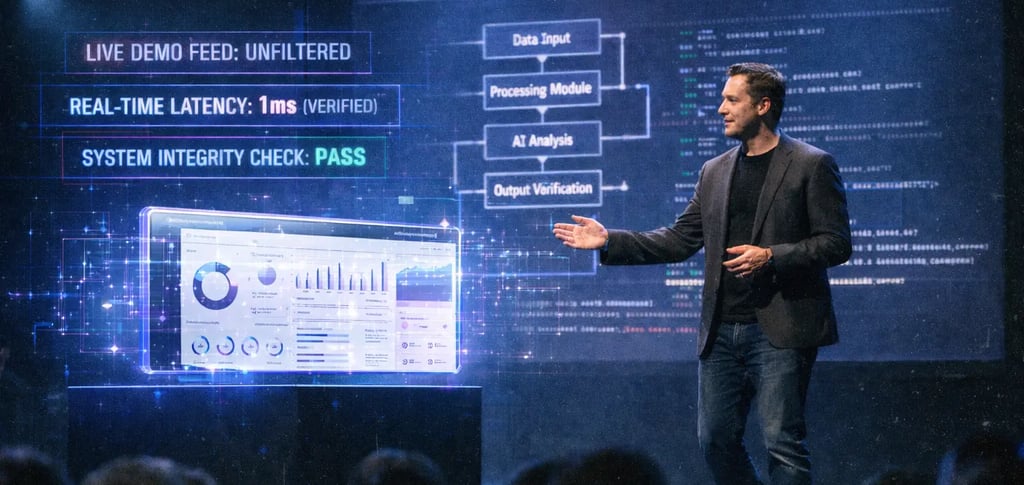
A slide deck promises the future. A live demo proves the present. In the courtroom of Venture Capital, the demo is your physical evidence.
In the hierarchy of fundraising assets, the Live Demo sits at the very apex of the risk-reward curve. It is the only moment in the entire Due Diligence process where the investor is not looking at a representation of your business (like a deck or a model), but at the business itself.
A slide can lie about efficiency. A financial model can hallucinate growth. But Latency does not lie. A user interface (UI) that requires seven clicks to perform a critical action does not lie. A dashboard that loads instantly with real, messy data creates a "Trust Event" that no amount of charismatic speaking can replicate.
For a Technical Founder, the demo is the "Trust Anchor." If you can navigate a live environment with speed and fluidity, you prove operational competence without saying a word. However, for 90% of founders, the demo is a "Valuation Trap." They treat it like a Customer Success tutorial ("And here is the settings menu..."), boring the investor to tears and highlighting the product's complexity rather than its value.
This analysis is a surgical dissection of the Live Demo Protocol. We will strip away the "feature tour" mentality and replace it with "Product Storytelling"—a forensic narrative technique that uses software to prove a thesis, not just to show off code. We will explore the Cognitive Science of UI, the Physics of Cursor Choreography, and the Psychology of Verisimilitude (making the fake look real).
This sub pillar is part of our main Pillar 10 — Pitch Delivery
The Trench Report: The "Settings Menu" Suicide (A Seed Round Collapse)
In Q4 2025, I audited a Construction Tech founder in Austin. He was raising $3M. He had built a powerful mobile app for site managers to track materials.
The Structural Error:
He opened the demo on Zoom.
Minute 1: He spent 45 seconds fumbling with the login screen because he forgot the password for the demo account.
Minute 2: Once in, he went straight to the "Profile Settings" to show how customizable the app was. "See, you can change the color theme here," he said proudly.
Minute 4: He was still explaining the "Notification Preferences."
The Investor Reaction: The Partner checked his watch. The investor's "Time-to-Value" calculation was trending toward infinity. The investor didn't care about dark mode; he cared about how the app saved a construction site $10k a day.
The Forensic Result:
The meeting energy flatlined. The feedback was brutal: "Product seems clunky and early."
The Reality: The product was robust. The demo was clunky. The founder had confused "Functionality" with "Value."
The Technical Pivot:
We implemented the "James Bond Open."
The Fix: We started the demo already logged in, on the specific screen where the "Magic Moment" happens (The Material Shortage Alert Dashboard).
The Script: "I’m going to skip the setup and show you exactly how a Site Manager saves $5,000 in 30 seconds."
The Action: He clicked one button. A report generated. He closed the laptop.
The Time: 45 seconds total.
The Result:
The investor leaned in. "Wait, show me that again. How did it pull that data?" The demo became a hook, not a bore. He closed the round because he demonstrated "Velocity of Value."
The Forensic Formula: The Value Velocity Ratio Vv
You must measure the speed of your demo's impact mathematically.
Vv = Dollar Value of Problem Solved
Number of Clicks to Solve It
Forensic Benchmarks:
Low Vv: 10 clicks to save $5. (Consumer App). Hard to fund.
High Vv: 1 click to save $50,000. (Enterprise SaaS). Unicorn potential.
The Goal: Your demo must mathematically prove a High Vv.
The Architecture of a Forensic Demo
A fundraising demo is fundamentally different from a sales demo. A sales demo teaches the user how to use it. A fundraising demo proves why the market needs it.
Phase 1: The "Cold Open" (The Hook)
The Rule: Never start at the Login Screen or the Dashboard Home.
The Logic: Watching someone type a password is the lowest value activity in business. Dashboards are often generic.
The Protocol: "The Chef's Table." Have the "Finished Dish" ready. Start deep inside the workflow where the conflict is resolved.
The Script: "This is the screen a VP of Sales sees at 4:59 PM on a Friday. It tells him exactly which three deals are at risk. Let's fix one."
Phase 2: The "Persona Toggle" (The Empathy Engine)
The Rule: Don't say "I click here." Say "She clicks here."
The Logic: Investors invest in markets, not tools. You must humanize the software.
The Protocol: "Role-Playing." Assign a name to the user.
The Script: "Meet Sarah. She's a compliance officer. Usually, she is terrified of an audit. But with our tool, she sees this red alert. She clicks 'Resolve.' Now watch the audit log update in real-time."
The Effect: This creates Narrative Transportation. The investor stops looking at pixels and starts imagining Sarah's relief.
Phase 3: The "Under the Hood" (The Technical Proof)
The Rule: Only go deep if asked.
The Logic: Investors assume the backend works. Only technical VCs (Deep Tech) want to see the API calls.
The Protocol: "The Layer Reveal."
The Script: "The UI is simple by design, but the engine is complex. If you're interested, I can show you the graph database structure that powers this real-time sync. Should we double-click on that?"
The Strategy: This is a "Competence Trap." If they say yes, you win because you know your tech. If they say no, you win because you offered transparency.
Visual Psychology & Cursor Choreography
The movement of your mouse on the screen dictates the eye movement of the investor. This is "Cursor Choreography."
1. The "Laser Pointer" Technique
The Issue: A static screen is boring. The human eye is a motion detector. If nothing moves, the brain goes to sleep (microsleeps).
The Fix: "The Circular Anchor."
When talking about a specific number (e.g., Revenue), circle it slowly with your mouse cursor.
Do not thrash the mouse wildly (creates anxiety).
Do move deliberately to guide their foveal (focused) vision.
2. The "Negative Space" Audit
The Issue: "Clutter." Screens with 50 buttons look like "Work."
The Fix: "The White Space Rule."
If your UI is cluttered, zoom out to 90% or hide sidebars during the demo.
Forensic Insight: Investors associate "White Space" with "Modern Tech." They associate "Dense Tables" with "Legacy ERP." Even if your product is complex, frame the demo to look clean.
3. The "Resolution" Hazard
The Issue: Your laptop is 4K. The projector is 1080p. The Zoom compression is high.
The Result: Your beautiful code looks like ants on a screen.
The Fix: "The 125% Rule."
Always set your browser zoom to 125% or 150% before the meeting starts.
Test readability by standing 6 feet back from your monitor.
Regional & Sector Calibration
How you demo depends on the geography of the money and the sector of the startup.
San Francisco (The "Magic" Demo)
The Vibe: Visionary, Glitch-Tolerant, Design-Obsessed.
The Strategy: "The Happy Path."
Show the perfect use case where everything goes right.
Focus on the "Delight" (Micro-interactions, animations).
Risk: If it looks ugly, even if it works, they will pass. In SF, "Design is a Moat."
London / New York (The "Stress Test" Demo)
The Vibe: Skeptical, Edge-Case Focused, Data-Obsessed.
The Strategy: "The Robust Path."
Show what happens when things go wrong (e.g., "Here is how we handle a data conflict").
Focus on "Data Integrity" and "Audit Trails."
Risk: If you gloss over the complexity, they assume you are "Vaporware."
Deep Tech / API First (The "Matrix" Demo)
The Challenge: How do you demo a backend API that has no UI?
The Strategy: "The Visualization Wrapper."
Do not show code in a dark terminal.
Build a simple "Feeder App" (a basic UI) that visualizes the data flowing.
Or: Use a real-time log stream that moves fast. Speed implies power. "Watch the request volume hit 10,000 rps."
The "Verisimilitude" of Data
Nothing destroys trust faster than "Fake Data."
Red Flag 1: "Lorem Ipsum" & "John Doe"
The Error: Showing a dashboard populated with "Test User 1," "Test User 2," or Latin filler text.
The Forensic Reality: It signals that the product is a prototype, not a business. It lacks gravitas.
The Fix: "The Data Seed."
Spend a weekend writing a script to populate your demo database with real-looking data.
Use real names (e.g., "Acme Corp," "Wayne Enterprises").
Use messy numbers. A graph that goes up in a perfect 45-degree line looks fake. A graph with volatility looks real.
Red Flag 2: The "White Label" Ego Bait
The Error: Using generic branding.
The Hack: "The Endowment Effect."
If you are pitching Sequoia, put the Sequoia logo inside your app's dashboard as the "Client Name."
Psychology: When they see their own logo inside the product, they subconsciously feel they already own it. It bridges the gap between "Your Tool" and "Our Tool."
Red Flag 3: The "Apology Spiral" (Crash Protocol)
The Error: The app crashes. The founder says: "Oh no, sorry, this never happens. It's the Wi-Fi. Sorry."
The Forensic Reality: You look panicked. You have lost frame control.
The Fix: "The Stoic Pivot."
Action: Close the laptop lid instantly.
Script: "Looks like the demo gods are humbling us today. I have a video backup of this exact workflow. Let's switch to that so I don't waste your time."
Psychology: You prioritized their time over your ego. That is CEO behavior.
Earned Secrets
Hidden levers of demo mastery used by elite founders.
Secret 1: The "Loom" Pre-Read
The Secret: You don't always need to demo live in the first meeting.
The Hack: Record a perfect, edited 3-minute Loom video of the demo.
The Strategy: Send this before the meeting with the teaser deck.
The Move: In the meeting, ask: "Did you get a chance to watch the 3-minute product tour?"
If Yes: "Great, let's skip the basic demo and talk about the architecture." (Saves time).
If No: "No problem, I'll do the 2-minute live version."
Secret 2: The "Localhost" Safety Net
The Secret: Cloud demos are risky (Server lag, Wi-Fi outage).
The Hack: Run the demo on Localhost (your own machine), not the production server.
The Move: Have a "Staging Environment" that is hard-coded to be fast and offline-capable.
The Signal: It ensures zero latency. Speed = Competence.
Secret 3: The "Comparison" Window
The Secret: Value is relative.
The Hack: Have two windows open side-by-side.
Left Window: The "Old Way" (Excel, Competitor, Chaos).
Right Window: "Your Way" (Clean, Fast, Automated).
The Move: "On the left is how they do it today (pain). On the right is how we do it (bliss)."
The Science: This leverages Contrast Bias. The brain values the solution more when it sees the pain immediately adjacent to it.
Expert FAQ: The Unasked Questions
Q: Should I let the investor click around?
A: Forensic Answer: No.
Why: They don't know the UI. They will click the one button that is broken or empty. They will get confused. Confusion = Pass.
Exception: Unless it is a Consumer App (Game/Social) designed for zero-instruction onboarding. For B2B SaaS, you drive the car; they watch the scenery.
Q: What if I don't have a product yet? (Pre-Seed)
A: Forensic Answer: Use "Figmaware."
Strategy: Build a high-fidelity interactive prototype in Figma.
The Move: Present it as if it is code. "This is the design architecture."
Honesty Check: Be clear. "This is the high-fidelity UX. The backend is being built in Q3." Do not lie and say it is live code. But show it live.
Q: How long should the demo be?
A: Forensic Answer: 5 Minutes Max.
The Math: A Partner meeting is 45 minutes.
5 mins: Intro/Frame.
15 mins: Deck/Narrative.
5 mins: Demo. (The Hook).
20 mins: Q&A.
Warning: If the demo goes over 10 minutes, you have lost the strategic narrative. You are now in the weeds. You are training them, not selling them.
Forensic Audit Checklist
Before you open your laptop, run the "Demo Diagnostic":
The "Clean State" Check: Did you clear your browser tabs? (No embarrassing search history, no competitor research tabs open).
The "Login" Bypass: Are you already logged in on the "Money Screen"?
The "Data" Audit: Is the demo data realistic? (No "Lorem Ipsum" text, no "Test User").
The "Resolution" Check: Is your browser zoomed to 125%?
The "Notification" Block: is "Do Not Disturb" on? (A Slack message popping up from your co-founder saying "Did we get the money?" is fatal).
Narrative Breadcrumb
You have executed the perfect demo. You skipped the settings menu. You showed the "Magic Moment" in 15 seconds. You handled the "Stress Test" with a backup video. The investor has seen the "Product Reality" and believes it is real.
The meeting ends. The partner says, "The product is slick. Let's talk about the round." Now you enter the most delicate phase of the entire process. You must navigate the "Term Sheet Negotiation" without losing the leverage you just built.
(Note: The Funding Blueprint Kit includes Founder-Proofed Frameworks built on real-world investor reactions and the Slide-By-Slide VC Instruction Guide. These resources decode the specific VC psychology behind every potential objection, ensuring you don't just memorize a script, but internalize the logic required to survive the audit. Access the full forensic suite at the home page.)
Funding Blueprint
© 2025 Funding Blueprint. All Rights Reserved.