
Handling Rejection, Objections & Investor Pushback: The Physics of "No"
Handling Rejection & Objections: "No" is rarely final. Master the Resistance Coefficient and "Loop Protocol" elite London and NYC founders use to turn a "Pass" into a "Term Sheet."
PILLAR 10 — PITCH DELIVERY
1/7/20269 min read
Handling Rejection, Objections & Investor Pushback: The Physics of "No"
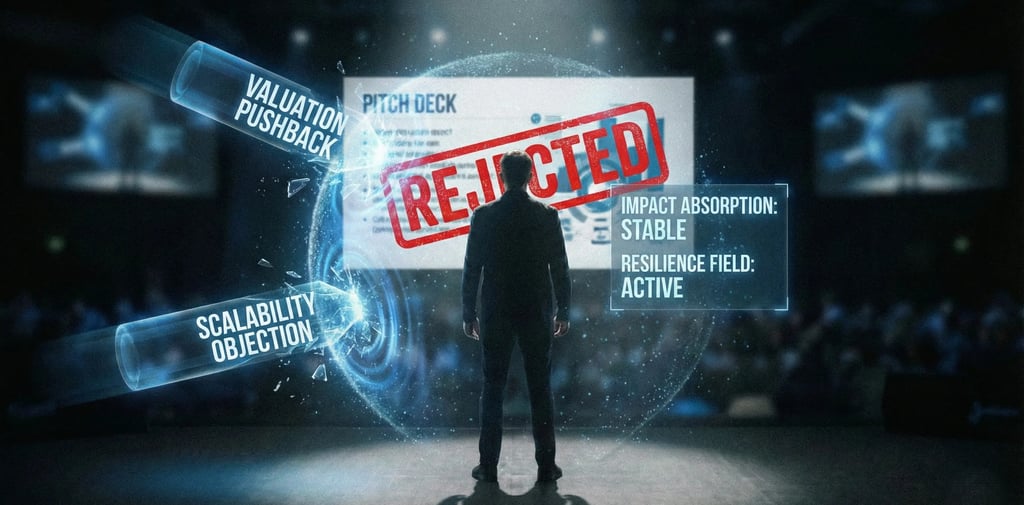
A "No" is not a failure of your business. It is a data point in a probabilistic search algorithm. In the physics of fundraising, Friction (Objections) is proof of Motion (Interest).
In the high-velocity world of Venture Capital, the default state of the universe is "No." A General Partner (GP) at a Tier-1 fund sees 5,000 deals a year and invests in 2. That is a 0.04% selection rate. Therefore, if you cannot metabolize rejection efficiently, you will burn out before you close.
However, the amateur founder views rejection as an emotional judgment on their self-worth. The forensic founder views rejection as "Market Feedback" and "Stress Testing."
Critically, most founders fail to distinguish between an "Objection" (a request for more data or a test of conviction) and a "Rejection" (a termination of interest). They hear a tough question like "Why isn't your CAC lower?" and interpret it as a "No," becoming defensive or defeated. In reality, a tough question is a "Buy Signal." Investors do not waste mental energy stress-testing companies they don't care about. If they are grilling you, they are interested.
This analysis is a surgical dissection of the Rejection & Objection Protocol. We will strip away the "resilience" fluff and focus on the Tactical Rhetoric required to turn a "Maybe" into a "Yes," and how to extract high-value intelligence from a "Hard No."
This sub pillar is part of our main Pillar 10 — Pitch Delivery
The Trench Report: The "Debater" Collapse (A Series B Suicide)
In Q2 2025, I coached a Series B DeepTech founder in London. He was raising £15M for a quantum computing interface. He was intellectually brilliant but operated with high "Founder Ego." He was pitching a conservative institutional fund.
The Structural Error:
The Investor asked a standard "Downside" question: "I worry that your reliance on a single GPU supplier creates a supply chain risk. What happens if Nvidia allocations drop?"
The Founder's Reaction: He took it as an insult to his operational competence. He interrupted: "That’s a rudimentary view of the supply chain. We have contracts in place. You're ignoring the fact that we are a priority partner."
The Dynamic: He tried to "Win the Argument."
The Forensic Result: He won the argument (he was legally right about the contracts), but he lost the deal.
The Verdict:
The investor passed. The feedback was specific: "Founder is abrasive and lacks emotional maturity." The investor wasn't testing the supply chain mechanics; he was testing the founder's reaction to stress. If he snaps at a potential board member, he will snap at employees.
The Technical Pivot:
We implemented the "Validator Protocol."
The Fix: In the next meeting, when challenged on a similar risk, the founder paused for 3 seconds.
The Script: "That is a very sophisticated risk to identify (Validation). You are right, if we were a standard client, we would be dead. However, because we are a beta-partner for their new chip, we have a 'guaranteed allocation' clause. Here is the contract."
The Result:
He closed the round. By validating the investor's skepticism first, he turned the dynamic from "Adversarial" to "Collaborative."
The Forensic Formula: The Resilience Ratio Rr
You can measure a founder's ability to handle pushback mathematically.
Rr = Time Spent Listening to Objection
Time Spent Defending (Arguing)
Forensic Benchmarks:
Rr < 0.2: Defensive. (Interrupting, arguing, speaking over). Result: Pass.
Rr > 1.0: Analytical. (Listening deeply, answering precisely). Result: Advance.
The Taxonomy of "No" (Advanced Classification)
Not all rejections are created equal. You must classify the "Species" of the rejection to determine your tactical response. We have expanded this taxonomy to include "Shadow Rejections."
Type 1: The "Ghost" (The Option Preserve)
The Signal: You send the deck. Silence. You follow up. Silence.
The Mechanism: They are not interested enough to meet, but they don't want to close the door in case you become a unicorn later. It is "Optionality Preservation." They are hoarding the option to invest later without paying for it now.
The Protocol: "The Breakup Email."
Script: "Hi [Name], I assume this isn't a fit right now, so I'm closing your file to focus on funds in diligence. I'll keep you on the newsletter."
Effect: This triggers Loss Aversion. 30% will reply instantly because humans hate having options removed.
Type 2: The "Soft No" (The Friend Zone)
The Signal: "You're too early for us. Keep us posted on traction." or "We love the team, but the market is small."
The Mechanism: "We like you, but the metrics don't justify the risk yet." This is usually code for: "We don't see the Venture Scale yet."
The Protocol: "The Nurture Loop."
Action: Do not argue. Arguing with a Soft No turns it into a Hard No. Move them to a "Quarterly Update" list in your CRM.
Goal: Prove them wrong with data over time. When you hit the metrics ($1M ARR), they are the easiest to close because the relationship is already built. Use the "Line, Not Dot" theory: Show them a trend line of progress over 3 months.
Type 3: The "Hard No" (The Thesis Mismatch)
The Signal: "We don't believe in this market size." or "We have a competitive conflict."
The Mechanism: Structural incompatibility. They simply cannot invest (e.g., they backed your competitor, or their LP agreement forbids this sector).
The Protocol: "The Extract."
Action: Accept it instantly. Do not burn the bridge.
The Move: Ask for a referral. "Understood. Since you know this space well, who are the 2 other investors you think would love this specific thesis?" This turns a dead lead into 2 new leads.
Type 4: The "Shadow No" (The Internal Politics)
The Signal: The Partner loves you, but the deal dies in the "Monday Partner Meeting."
The Mechanism: The Partner failed to sell you to their partnership. This is not a failure of your business; it is a failure of your "Internal Champion."
The Protocol: "The Ammo Drop."
Action: Before the Monday meeting, equip your champion with a "1-Page Cheat Sheet" handling the specific objections of their skeptical partners. You have to help them fight the internal war for you.
The "Objection Ju-Jitsu" (The A.R.C. Protocol)
When an investor pushes back (e.g., "Your CAC is too high"), do not defend. Defense implies guilt. Use the A.R.C. Framework to pivot the energy.
Step 1: Acknowledge (The Cushion)
The Psychology: Disarm the conflict. Make them feel smart. Investors want to be seen as "Smart Money." If you validate their insight, you feed their ego.
The Script: "That is a great observation." or "You are right to point that out, it is historically the biggest risk in this sector."
The Effect: It lowers their cortisol. They stop fighting you because you just agreed with them. You are now on the same side of the table looking at the problem together.
Step 2: Reframe (The Pivot)
The Psychology: Change the context of the data. Take the "Negative Fact" and reinterpret it as a "Positive Strategy."
The Script: "However, the reason the CAC looks high right now is because we are aggressively bidding on 'Enterprise' keywords, not 'SMB' keywords."
The Effect: You turn a "Bug" into a "Feature." (High CAC is not inefficiency; it's a strategic choice to target high LTV customers).
Step 3: Close (The Evidence)
The Psychology: Prove it with data. A narrative pivot is weak without numerical evidence.
The Script: "If you look at our LTV:CAC ratio for those Enterprise customers, it's 5:1. So we are actually printing money on that high CAC. Let me show you the cohort slide."
The Advanced Move: "The Pre-Emptive Close." After showing the data, ask: "Does that address your concern about unit economics, or is there another layer we should dig into?" This forces them to verbally agree that the objection is resolved.
Regional & Sector Calibration
The nature of the pushback changes by geography and sector.
San Francisco (The "Upside" Pushback)
The Objection: "Is this big enough?" "Why isn't this a $10B company?"
The Trap: Being "Realistic." ("Well, we conservatively project $100M...").
The Fix: "Uncap the Ceiling."
Response: "If we only win the US, it's $100M. But the platform play allows us to enter Fintech, which makes this a $10B outcome. Here is the path to that."
London / New York (The "Downside" Pushback)
The Objection: "What if Google enters?" "What if rates go up?"
The Trap: Being "Dismissive." ("Google is slow, they won't do it.").
The Fix: "The Hedgehog Defense."
Response: "We have stress-tested that. We have 3 years of runway in a 'Zero Growth' scenario. We are default alive. Here is the downside model."
Deep Tech vs. SaaS
Deep Tech Objection: "Will the physics work?" (Technical Risk).
Response: Show the patent, the prototype, the white paper. Do not use marketing slides.
SaaS Objection: "Can you sell it?" (Distribution Risk).
Response: Show the pipeline, the CAC, the sales team.
Forensic Note: Never answer a Distribution question with a Technical answer. (e.g., "We can sell it because the code is clean" = Failure).
The "Integrity" Red Flags
How you handle an objection you can't answer determines your character score.
Red Flag 1: The "Bluff"
The Error: Making up a number when challenged.
The Forensic Reality: Investors have benchmarks. If you say "Our retention is 99%" for a consumer app, they know you are lying or incompetent.
The Fix: "The Unknown Pivot."
Script: "I don't have that exact figure, and I don't want to guess. I'll pull the SQL query tonight and email you the exact number."
Red Flag 2: The "Personal Offense"
The Error: Getting visibly angry or flushed when they insult your "Baby" (Product).
The Forensic Reality: Business is not personal. If you get emotional, you are a liability.
The Fix: "The Stoic Nod."
Treat the feedback as if they are critiquing a third-party object. Disassociate your ego from the code.
Red Flag 3: The "Straw Man" Defense
The Error: Answering a question they didn't ask because you don't like the real question.
The Forensic Reality: This is evasive. It signals you are hiding a weakness.
The Fix: "The Isolate."
Script: "Before I answer that, is price your only concern, or is there something else?" Isolate the objection to ensure you are solving the real problem.
Earned Secrets
Hidden levers of rejection management used by elite founders.
Secret 1: The "Shadow Portfolio"
The Secret: Sometimes they say "No" because they are about to invest in your competitor, but they can't tell you yet.
The Hack: If the questions are suspiciously specific about your secret sauce (e.g., "How exactly does the algorithm weight X vs Y?"), stop answering.
The Move: Ask: "Are you currently in diligence with any similar companies in this space? I want to respect your conflict of interest policies." Watch their body language.
Secret 2: The "Backchannel" Feedback
The Secret: They will never tell you the real reason they passed. They will give you a generic reason ("Market size").
The Hack: Ask a friendly founder in their portfolio to ask the partner: "Hey, why did you pass on [Your Name]?"
The Result: The Partner will tell the portfolio founder the truth: "He seemed disorganized," or "The CTO is weak." This is the only way to get the "Forensic Truth" to improve.
Secret 3: The "Pre-Emptive Strike"
The Secret: You know your biggest weakness. They will find it.
The Hack: Bring it up before they do.
The Script: "Now, looking at this slide, you're probably thinking the margins look low. And you're right. Here is why..."
The Result: This builds massive trust. You are not hiding; you are leading. It is impossible to attack a founder who has already attacked themselves.
Expert FAQ: The Unasked Questions
Q: Should I try to change their mind after a "No"?
A: Forensic Answer: No.
Logic: Once a partnership has voted "No," it is politically impossible to reverse it immediately. You look desperate.
Exception: Only if you have a "Material Change" (e.g., You signed a contract worth $1M/year the next day). Then you can say: "Given this new material event, does this change your calculus?"
Q: How many "No's" is too many?
A: Forensic Answer: It depends on the cluster.
Metric: If you get 30 "No's" from qualified leads (funds that invest in your sector/stage), your pitch is broken, or your business is broken. Stop. Audit. Pivot.
Note: If you get 30 "No's" from unqualified leads (e.g., pitching a Crypto fund a BioTech startup), that is just bad targeting.
Q: Can I ask for feedback?
A: Forensic Answer: Yes, but make it easy.
Script: "I know you're busy, but if you could point to the ONE thing that killed this for you, it would help me immensely."
Result: Specific questions get specific answers. General questions get silence.
Forensic Audit Checklist
Before you enter the meeting, prepare your "Defense Shield":
The "Pre-Mortem": Write down the 5 reasons you would not invest in your company. (High burn, single founder, etc.).
The "Judo Scripts": Prepare an A.R.C. response for each of those 5 risks.
The "Competitor Map": Know every competitor better than they do. If they mention a startup you haven't heard of, you fail.
The "Walk Away" Price: Know the terms you will not accept. (e.g., "I will not accept a 2x Liquidation Preference").
The "Emotional Anchor": Do a breathing exercise. Remind yourself: "I do not need this specific person's money. I need the right money."
Narrative Breadcrumb
You have navigated the minefield. You turned the "Assassin" question into a proof point. You accepted the "Soft No" with grace and moved them to a nurture list. You didn't just survive the pushback; you used it to demonstrate your "Antifragility."
The meeting ends. The partner is impressed not just by the business, but by the Founder. They saw someone who can handle the pressure of a Boardroom. They say, "Let's move to a Term Sheet." Now, the game shifts from "Psychology" to "Legality." You need to understand the fine print that can kill you.
(Note: The Funding Blueprint Kit includes Founder-Proofed Frameworks built on real-world investor reactions and the Slide-By-Slide VC Instruction Guide. These resources decode the specific VC psychology behind every potential objection, ensuring you don't just memorize a script, but internalize the logic required to survive the audit. Access the full forensic suite at the home page.)
Funding Blueprint
© 2025 Funding Blueprint. All Rights Reserved.