
Handling Investor Questions: The Art of the Audit
Handling Investor Questions: "I don't know" is better than a lie. Master the Bridge Protocol and Defensiveness Ratio elite London and NYC founders use to survive the Q&A audit.
PILLAR 10 — PITCH DELIVERY
1/6/20267 min read
Handling Investor Questions: The Art of the Audit
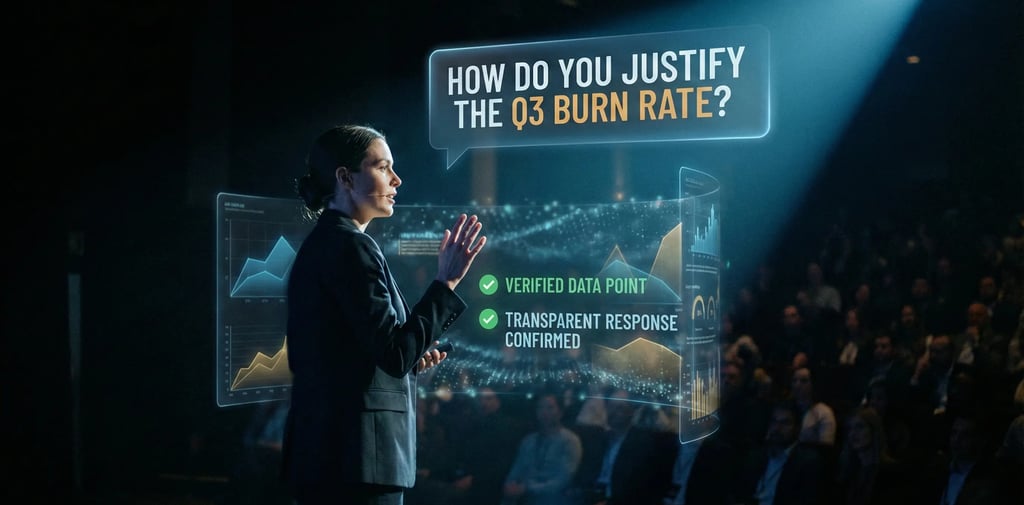
The pitch deck gets you the attention. The Q&A gets you the check.
The most dangerous misconception in fundraising is that the "Pitch" is a monologue. It is not. The pitch is merely the opening statement in a trial where you are both the defendant and the star witness. The verdict—funding or rejection—is determined almost exclusively during the Interrogation Phase (Q&A).
In a forensic audit of failed rounds, we find that 80% of founders "die" in the Q&A. They deliver a flawless 15-minute presentation, but the moment a Partner asks a sharp question about Unit Economics or Competitive Moats, the founder crumbles. They become defensive, they guess, or they ramble.
When a General Partner (GP) asks you a hard question, they are not just asking for data. They are stress-testing your "Cognitive Architecture." They want to know:
Do you panic under pressure? (CEO Psychology).
Do you know the levers of your business? (Operational Competence).
Are you honest when you don't know? (Integrity Audit).
This analysis is a surgical guide to Diligence Defense. We will strip away the "media training" fluff and focus on the Tactical Rhetoric required to survive the boardroom audit. We will explore how to classify questions, how to pivot hostile inquiries, and how to use the Q&A to raise your status from "Applicant" to "Peer."
This sub pillar is part of our main Pillar 10 — Pitch Delivery
The Trench Report: The "Defensive Spiral" (A Series A Collapse)
In Q3 2025, I audited a Series A HealthTech founder in Boston. She was raising $8M. She had a strong product but a complex regulatory hurdle. She was pitching a Tier-1 firm known for rigorous diligence.
The Structural Error:
The Partner asked a "Trap Question": "I see you're targeting hospitals. But isn't the sales cycle 18 months? How do you survive that burn?"
The Founder's Reaction: She felt attacked. Her cortisol spiked. She interrupted the investor: "No, that's not right. You're looking at old data. We have a pilot that closed in 3 months. The market is changing."
The Forensic Result: The Partner crossed his arms. The founder had committed the "Status Violation." She corrected the investor aggressively rather than validating the concern. The rest of the meeting was an argument, not a negotiation.
The Verdict:
Pass. Feedback: "Founder is defensive and uncoachable."
The Technical Pivot:
We implemented the "A.R.C. Protocol" (Acknowledge, Reframe, Close).
The Fix: In the next meeting, when asked the same question, she paused.
The Script: "That is a great observation (Acknowledge). Historically, hospital sales cycles are indeed 18 months, which kills startups. That is exactly why we built a 'Bottom-Up' entry strategy targeting individual departments first (Reframe). This lowered our cycle to 4 months. Let me show you the cohort data (Close)."
The Result:
She validated the investor's intelligence ("Great observation") while proving her own competence. She closed the round because she turned an objection into a proof point.
The Forensic Formula: The Answer Efficiency Ratio Ea
You can measure the quality of an answer mathematically.
Ea = Direct Answer (Yes/No/Number)
Time to Answer (s)
Forensic Logic:
High Ea: "Yes, our churn is 2%. Here is why." (High Status).
Low Ea: "Well, churn is a complex topic, and you have to understand the market..." (Low Status / Evasive).
Rule: Answer the question in the first sentence. Explain in the second.
The Taxonomy of Investor Questions
Not all questions are created equal. You must classify the "Species" of the question before you answer.
Type 1: The "Validator" (The Softball)
The Intent: They want to verify a basic fact to check if they understood the slide.
Example: "Is this revenue GAAP or GMV?"
The Protocol: Binary Speed. Answer in one word if possible. "GAAP." Do not elaborate. Speed creates competence.
Type 2: The "Assassin" (The Thesis Killer)
The Intent: They have identified a fatal flaw (e.g., competition, regulation) and want to see if you have solved it.
Example: "Why won't Google just build this feature and kill you?"
The Protocol: The "Judo" Pivot. Do not fight the premise. Accept it, then explain your specific moat.
Script: "They absolutely could, and they likely will. However, Google cannot sell to [Specific Customer] because of [Data Privacy/Neutrality]. We win because we are Switzerland, and they are the Empire."
Type 3: The "Trap" (The Integrity Test)
The Intent: They ask a question they know you probably don't know the answer to, or one that tempts you to lie.
Example: "What is the exact CAC of your tertiary competitor?"
The Protocol: The Integrity Pivot. Never guess.
Script: "I don't have their internal data, so I won't speculate. However, based on their ad spend estimates, we model it at ~$200, which is 2x ours."
Type 4: The "Visionary" (The Upside Test)
The Intent: They want to see if you can dream big.
Example: "If everything goes right, how big can this get?"
The Protocol: Uncap the Ceiling. Do not talk about reasonable growth. Talk about "Category Domination."
Regional Calibration (SF vs. London)
The Q&A style is culturally dependent.
San Francisco (The "What If?" Culture)
The Vibe: Collaborative Brainstorming.
The Questions: They are often hypothetical and expansive. "What if you gave the hardware away for free? Could you capture the market faster?"
The Strategy: "Improvise." Play the game. Say, "That's an interesting thought experiment. If we did that, we would need $50M in capital, but we could own 80% of the market. Is that a play you're interested in?"
Forensic Risk: Being too rigid or "realistic" kills the vibe.
London / New York (The "How?" Culture)
The Vibe: Forensic Audit.
The Questions: They are granular and risk-focused. "How do you hedge against FX risk if you expand to the US?"
The Strategy: "Data Defense." Show that you have thought about the downside. "We hold reserves in USD and have a natural hedge through our US cost base."
Forensic Risk: Being too hand-wavy or dismissive of risk kills the trust.
The "Red Flag" Tells in Q&A
Investors are watching how you answer more than what you say.
Red Flag 1: The "Filibuster"
The Error: Talking for 5 minutes to answer a simple question.
The Forensic Reality: This signals that you are insecure or don't know the answer. You are hoping that if you talk long enough, you'll hit the right keyword.
The Fix: The "Headline Rule." Give the headline answer first. Then ask, "Would you like me to go deeper into the mechanics?" This puts the control back in their hands.
Red Flag 2: The "Co-Founder Glance" (The Mommy Look)
The Error: The CEO gets asked a hard question and immediately looks nervously at the Co-Founder/CFO for help.
The Forensic Reality: The CEO is a figurehead. They are not in charge.
The Fix: The CEO must own the room. If you need the CTO to answer, delegate with authority: "That’s a great question on architecture. [Name], walk them through the stack." Do not look for permission; give the command.
Red Flag 3: The "Defensive Crouch"
The Error: Crossing arms, leaning back, or raising voice pitch when challenged.
The Forensic Reality: Uncoachable. If you fight me now on a $50k question, you will fight me later on a $50M decision.
The Fix: "Lean In." When a question is hostile, physically lean in and lower your voice. It signals curiosity, not defense.
Earned Secrets
Hidden levers of Q&A mastery.
Secret 1: The "Appendix Jump" (The Preparation Signal)
The Secret: The best answer is not a word; it is a slide.
The Hack: When they ask a complex question (e.g., "What is your cohort retention?"), do not just say "90%."
The Move: Say, "Great question. Let's look at the data." Hit [Slide Number] + Enter to jump instantly to the Appendix slide with the Cohort Chart.
The Impact: It proves you anticipated the audit. It changes the dynamic from "Trust me" to "Look at the evidence."
Secret 2: The "Reverse Q&A" (The Status Flip)
The Secret: A pitch is a two-way interview.
The Hack: If the investor asks, "What keeps you up at night?" Answer it, then immediately ask, "What is the biggest risk you see in this deal based on your other investments in this space?"
The Impact: It forces them to be vulnerable. It establishes you as a peer who values their intellect, not just their wallet.
Secret 3: The "Pause" (The Confidence Hack)
The Secret: Insecure people fear silence. Secure people use it.
The Hack: When asked a tough question, pause for 2 full seconds. Look at them. Think. Then speak.
The Impact: It shows you are answering their specific question, not reciting a memorized script. It creates gravitas.
Expert FAQ: The Unasked Questions
Q: What if I truly don't know the answer?
A: Forensic Answer: Use the "Integrity Pivot."
Script: "I don't have that specific number off the top of my head, and I don't want to guess and give you bad data. Let me run that exact query tonight and email it to you by 9 AM tomorrow."
Follow-Up: You MUST send that email. It turns a "Lack of Knowledge" into a "Proof of Reliability."
Q: How do I handle a "Bad Cop" investor who is being rude?
A: Forensic Answer: Kill them with kindness.
Strategy: Do not get angry. Do not be sarcastic. Be hyper-professional.
Script: "I hear your frustration with the market. Our data suggests a different trend. Let's agree to disagree on that macro point, but let me show you how we are executing regardless."
Result: The other partners in the room will respect your composure. Often, the "Bad Cop" is testing your skin thickness.
Q: Should I interrupt the investor if they are rambling?
A: Forensic Answer: No.
Strategy: Let them finish. Investors love the sound of their own voice. If you interrupt, you bruise their ego. Wait for the breath, then pivot.
Forensic Audit Checklist
Before you enter the Q&A zone, run the "Defense Readiness" Diagnostic:
The Matrix: Have you filled out the "Q&A Matrix" (Top 50 hardest questions + Judo Answers)?
The Appendix: Do you have "Shadow Slides" for Churn, CAC, Competition, and Financials?
The Roles: Do you and your co-founder know exactly who answers what? (No fighting for the mic).
The Data: Do you know your "Holy Trinity" metrics (Burn, Growth, Margins) cold? (No looking at notes).
The Tech: Do you know the hotkeys to jump slides? (e.g., in PowerPoint/Keynote, typing "Number + Enter").
Narrative Breadcrumb
You have survived the interrogation. You pivoted the "Assassin" question. You used the "Appendix Jump" to prove your diligence. You validated the investor's concerns without being defensive.
The meeting ends. The partner nods and says, "This was a very productive discussion." But the check is not written. You are now in the "Closing Zone." You need to move from "Interest" to "Commitment."
(Note: The Funding Blueprint Kit includes Founder-Proofed Frameworks built on real-world investor reactions and the Slide-By-Slide VC Instruction Guide. These resources decode the specific VC psychology behind every potential objection, ensuring you don't just memorize a script, but internalize the logic required to survive the audit. Access the full forensic suite at the home page.)
Funding Blueprint
© 2025 Funding Blueprint. All Rights Reserved.